

Working with the viscera requires that we develop our kinesthetic abilities to sense a more complex arrangement of textures, densities, and movements. Understanding the tissue qualities of visceral anatomy can help us. The fundamental materials and organizing principles of these tissues are the same as those of the myofascial tissues we know as Rolfers. Yet the tissues of the myofascial system are exponentially more homogenous than the tissues of the visceral system.
Let’s look at what we have come to understand and be able to sense about tissue quality from working with the myofascial system.
Scope of Practice
When working with the viscera it is important that we keep our goals and techniques within the structural integration (SI) scope of practice. In SI we use fascial manipulation, movement education, and awareness to achieve improvements in somatic alignment, function, and presence. These improvements can lend to, but not guarantee, a better quality of life.
Our work is with those elements that give shape and function to the architecture of the body, the connective-tissue matrix, and the nervous system. Visceral work, though it often utilizes indirect assessments and treatment techniques, remains a work with, to, and for the connective-tissue matrix and autonomic nervous system.
People often ask if work with the viscera can help with physiological illnesses. If the physiological problem is caused, in whole or in part, by fascial restrictions, then visceral work might help. Any promise beyond that is beyond our scope of practice. As most standard and complementary medicine is biochemical and/or energetic, structural improvement can be a vital contribution
There are some qualities in visceral tissue that make it a little simpler, relative to the myofascial system, to identify and assess:
The Qualities of the Visceral Tissue
Let’s look at how the visceral body is composed and arranged. There are many organs with many different shapes, densities, and functions all packed together inside compartments that are all different as well. Some of the compartments are hard, some soft; some are adaptable and some hardly adaptable at all. Inside of the compartments, the organs are rubbing against one another, folding over and around one another, and accepting and adapting to the passage of various materials and fluids necessary for life’s processes. The compartments are held close to one another and close to the boney and muscular surfaces of the structural body. Some organs can be found tightly attached to compartmental walls and some are floating free of such attachments.
There are tubular passageways, functioning as both conduits and support structures that interconnect all of the organs and compartments. Sometimes these tubes are firmer than the organs they connect and sometimes softer. Some organs join together into systems and subsystems to handle various physiological functions. The compartments separate these functions from one another and the tubular conduits connect them in precise and purposeful ways.
Visceral Culture
We can understand much about the organic qualities of the visceral body by studying its structure and function in words and images. However, working with the viscera can teach us about the deeper culture organizing these tissues and systems. Over time, the visceral body can show the receptive and polite tourist how to interact with its culture if that tourist wants to become a welcome agent of change. In the manner in which the organs are arranged, and in the composition of the various tissues throughout the visceral region, we can begin to know the primary tenets of this culture. This culture has come about by the process of evolution selecting out the most sustaining designs and arrangements and occasionally making a fortuitous mistake. Two qualities seem to be fundamental to this culture. First, a precise and unrelenting discrimination has to be primary and sacrosanct for the organs of the viscera to contain their different tissues and perform their different functions while residing so close to one another. Then, in order for all the different components and processes to occur in these compact spaces and still sustain life, an ongoing harmony of the whole must rise above the needs or capacities of any one part.
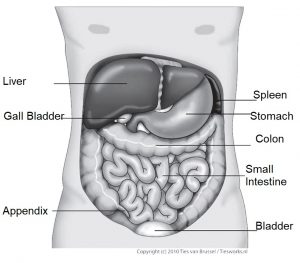
Figure 1: Visceral body anterior.
<i>Discrimination</i>
The organs discriminate themselves from one another by distinct differences in their tissues. To maintain these distinctions in close quarters, the fascia that externally wraps each organ prevents adhesion to other structures. Effectively, the boundary of each organ is saying to the other, “don’t become me.” The stomach can lie next to the spleen for a lifetime and never become adhered. The tubes of the small intestine entwine with one another and within and around the tubes of the colon and remain free. The flexures of the colon come up behind the liver on the right and stomach on the left and never adhere.
These boundaries can be violated with injury and illness. The organs can become adhered to one another by the introduction of a binding connective tissue, i.e. blood from internal bleeding or from blood spills during surgery. Prolonged inflammation can also cause a proliferation of binding connective tissue between organs. If an organ is inflamed for some time, gossamer fibers of connective tissue can attach between it and the other organs in constant contact with it. Blood adhesions are like thick scars or wads that lie between the organs they are adhering. Adhesions from inflammation are not as profound but still serve to create immobility between two organs that once were able to freely slide by one another.
<i>Harmony</i>
There are many different functions striving to happen within the visceral cavities. There are bags that can fill and empty by respiration, peristalsis, blood circulation, and consumption. All of the organs are in continual production of vital substances that need to be transported and arrive on time. At the same time, the organs need to allow the movements of the extrinsic structure to shift them around. Many organs are involved in tightly orchestrated physiological processes that need to have the steps occur in the appropriate sequence to adequately handle the body’s nourishment and cleansing. If any one organ would perform inappropriately for the situation, illness and even death could occur. This cohabitation and sequencing requires that a guiding harmony be maintained throughout the visceral core.
The harmony of the visceral core is regulated by a vast number of neurological and biochemical factors. A primary mechanism by which the status of any part of the viscera is communicated to the whole is mobility. When an organ is not able to function well (whatever the causal agent), there will be a change in its capacity for motion. Peristalsis can slow with constipation or speed up with poisoning. The liver can become sluggish with cirrhosis and toxicity. The kidneys can become sluggish with injury or overactivated by imbalances in the blood. No matter the cause, when an organ becomes more or less mobile it has an effect on the organs (and the extrinsic structure) near to it and within the same system as it: those neighbors and family members will respond, and their capacity for motion will change as well. These changes in the capacity for motion will mean a change in the overall health of the body. Because the body honors the needs of the viscera as primary, the extrinsic body will not place demands for motion on distressed organs.
Integration
Integration is the harmonious working together of distinct parts. Integration is an ongoing give and take between discrimination and harmony. With structural integration we are used to balancing the capacities and needs of one part of the body with the capacities and needs of another. This is also what needs to happen if we are going to attempt to transform the visceral tissues. We have to take into consideration the needs and capacities of all of the parts in transforming any one of them. Without that type of care we may get a random freedom but we will not assist with integration.
Working with Discrimination and Harmony The challenge in working with the viscera is to honor the fundamental capacity and need of each organ for discrimination and harmony. One reason this is so important is that if we do not work within these limitations, we are more likely to create distress and disease. Another reason is that we can accomplish more transformation and integration for the organ, the viscera, and the entire body if we work these primary tenets.
<i>Basic Guidelines</i>
<i>Liz Gaggini is a Certified Advanced Rolfer who practices in New York. She teaches a series of basic and advanced classes on her own approach to visceral work. She also teaches a series of basic and advanced classes in biomechanics. Information on her classes can be found at her website www. ConnectiveTissue.com. Her previous articles on visceral work and other subjects can be found online at the Ida P. Rolf Library of Structural Integration (www.pedroprado.com.br) and at www.ConnectiveTissue.com.</i>
Endnotes
Appendix: Why and How the Viscera Affect Structure
There are two very significant ways in which the viscera affect the structure. One is that the body will shape itself, even to the point of misalignment and restricted movement, to protect and assist an internal organ. It is as if the body honors visceral ease first and structural wellness second. Secondly, the viscera reside in the center of the body. Any restrictions in visceral fascia are directly transferred to the myofascial and body structures of the torso. This is especially true of the pelvic, respiratory, and thoracic diaphragms. The brain is also a visceral organ. The relationship of restrictions in the intracranial fascia to the structure of the cranium has the same local and global consequences for the structure. The major diaphragm of the cranium is the fascia associated with the sphenobasilar junction.
The organs are designed to cooperate with the body’s needs for alignment, balance, and movement. In general, there is a high elastic component to the visceral fascia and the visceral ligaments, which allows the viscera to move with the myofascial and bony structure without injury or inhibition. When there is a restriction in an area of the visceral fascia, it will interfere with that area’s capacity to move with the body. Any forced movement through the visceral restriction could injure or greatly inhibit the function of the viscera. It is rarely the case that the body will allow the viscera to be affected in this way. Instead, the body will inhibit the myofascial and bony structure to protect the viscera.
The body will go even further in its protection of the viscera. It will actively use the structure to create ease and assist with the function of a restricted organ. One common instance of this active use of the structure for the benefit of the viscera is seen when there is tremendous restriction in the stomach. The myofascial and bony structure will bend and twist to put the stomach into a position that creates ease for the stomach tissue and creates an optimum position for the stomach’s function. It is a hierarchy in the effort for survival – stomach function is more important than joint alignment.
As structural practitioners who work to align the myofascial and bony structure, we are often frustrated when all of our good work to resolve the sidebends and rotations or to create support and transmission seems of no avail. In these cases, we are often working against the survival hierarchy. Until visceral problems are resolved, structural changes will not hold.
In Memoriam
Structural Integration: The Journal of the Rolf Institute® notes the passing of the following members of our community (in alphabetical order):
Richard Hoska, Certified Rolfer™
Nina McIntosh, Certified Rolfer and author of The Educated Heart: Professional Boundaries for Massage Therapists, Bodyworkers, and Movement Teachers.