

Overview
For over ten years, we have been exploring the first developmental movement known as ‘yield’, as originally described by somatic innovator Bonnie Bainbridge Cohen in her Body Mind Centering system. This article combines contributions from both Hiroyoshi (Hiro) and Carol. Hiro’s contribution and insights into working with this gentle approach for shifting structure, movement patterns, coordination, and perception are documented through client photos and an understanding of cellular biology and the extracellular matrix. Carol explores yield in the context of embryology and movement awareness. This article presents a brief synopsis of our collaboration.
Yield is the first developmental movement. Often misunderstood as a passive surrendering or a ‘doing nothing,’ yielding is in fact an active coming into relationship and is the fundamental movement behavior underlying all others. Take a moment and recall an image of an infant resting securely on her mother’s chest. Sense the very tangible contact between them. There is a qualitative difference and feeling sense when an infant yields into this contact as contrasted with a collapse due to the flaccidity of an infant’s tonus or the absence of maternal bonding.
Yield underlies all other developmental movements and our basic relationship to the world.1
The action of yielding brings us into contact with the environment so that we can release our weight into gravity. As the weight of body mass is given over to gravity, a corresponding sensation of lift rises through our structure supporting other gestures and movement expression.
Yield is key to interoception: the ability to read and interpret sensations arising from the viscera and internal tissues of the body.2 It is an action that supports awareness and insures a deepening understanding and richness of our inner lives. The movement of yielding nourishes an explosion of sensation. Whether these sensations are pleasant, terrifying, frustrating, joyous, or painful we can yield into our comfort or discomfort in the moment and be with the true ground of our experience. This somatic understanding arising from yield may flow into expression. Allowing a moment of yielding, a split-second awareness of releasing into ground, begins to remap the familiar neurological pathways of movement. Yield is the essential ingredient for shifting tensional patterns dictating movement expression.
In our twenty-first century technologically ‘wired’ culture, our ability to yield is often absent in the movement vocabulary of our fast-paced lives. We scurry through the busy-ness of daily schedules often detached from the support of the grounding weight of our bodies and the resources of our environment. Perhaps that support comes from the terra firma allowing us to yield into the weight of our bones in order to push a cart, walk, or run to meet an appointment, move fascia, reach for a book, or rest into sensuous contact with a lover.
The active nature of yield, a coming into full-body awareness in relationship, is the foundation for all movement patterns. As adults, yield supports intimate contact with self, with others, and with our physical world. At the most basic level: to yield is to sense and to allow weight. This action supports the primary orienting relationship between our body as matter and the field of gravity we are embedded in.
Exploration
Take a moment (a pause) and notice how you are sitting. Are you resting into the support of the chair – or are you holding your body in a familiar way or tense way – separate from the support of the chair or floor? Notice the shape your body assumes as you continue reading. Become aware of tensions in your body, your eyes, your neck, and yield into the shape of this tensional holding pattern, feel it, breathe into it, know it. Can you name the sensorial quality of your body’s shaping or breathing pattern linked to the action of reading? As your awareness of this pattern deepens, does your body shape begin to change?
A very simple example of yield occurs daily in our working practice. A client lies on the table, yet doesn’t arrive on the table – she is bracing or holding her weight. We may gently rock the client’s limbs, support her weight from underneath, cue her verbally, etc., to assist her in ‘yielding’ into the table. Or we may engage with her to bring her awareness to the holding and use it as a moment of awareness. There are many different ways to work with it. Through allowing weight (yield – to meet/allow with awareness), we also increase our perception of proprioception, orientation, and self-understanding.3
Yielding into contact with our clients informs our touch. Touch is the earliest sense to develop in utero. Haptic communication is the means by which people and other animals communicate via touching. The development of the haptic senses and how they relate to the development of the other senses has been the target of much research. Human babies have been observed to have enormous difficulty surviving if they are not touched or held sufficiently, even if they retain sight and hearing. Babies who can perceive through touch, even without sight and hearing, tend to fare much better. Yielding is the basis of true and contactful touch. Touch may be thought of as a basic sense in that most life forms respond to being touched, while only a subset have sight and hearing.
Yielding is a physical expression of and support for emotional and social bonding; bonding is first experienced in relation to the body of mother, and the earth, as the infant yields her weight into her supporting surfaces. If the support is not felt to be secure and responsive to her needs, the infant cannot yield fully, and bonding will not be complete. Adequate touch and holding are essential to the bonding process and to physical and psychological well-being; this begins in the womb at the cellular level, but continues in various forms throughout life.4
Contributions from Embryology
Moment by moment the study of embryological development illustrates the action of primary yield. The meeting of egg (pulsating matter-gravity) and sperm (motility-electromagnetism) is one of coming into transformational contact. The fertilized egg or zygote is biologically driven to implant into the uterine wall. Hormonal flows and neurological predispositions of the mother may create a welcoming field or one that rejects the pregnancy. Either movement behavior directly imprints the developing embryo through the hormonal bath of elation or dismay. An embryo is an undulating, vibrating potential. However, if the uterine environment is one of rigidity, fear or terror, the embryo is unable to yield to its own inherent physiological motility. And reciprocally, the uterine field withdraws the secure ground of implantation. Carol notices in her Rolfing, Rolf Movement and craniosacral practice that the capacity for a client to yield to her own internal state of vulnerability, softness, and internal knowing often speaks to these pre-verbal, intrauterine dynamics.
The Embryonic Membrane: Where Am I?
Primary yield initiates the development of the embryonic membrane as container or envelope. Initially the skin boundary of the embryo is just one cell thick; however, its continuity cultivates the feeling sense of wholeness, and security. We experience our first orientation to gravity through our mother’s relationship to gravity. The mother’s sense of orientation becomes the orienting imprint for the embryo’s body mass in gravity. In utero, nourishment flows or is thwarted in the exchange from her body to the embryonic body. Autonomic tonus is set through this primary relationship. The membranous continuity of this envelope forms the linings of the viscera, lymph, cranial membranes connective tissues, and more. Internally, this membranous layering feeds internal sensation and the interpretations we give to those sensations (interoception). Externally, our skin forms a boundary of self and other and our world. Our skin envelope offers a sense of protection and safety. Yet this boundary is porous and affords a dynamic exchange between ourselves, another, and the environment.
As a practitioner cultivates her sensory experience of yield and receptivity of this embodied state, a ground of support rises within the therapeutic field. This engages the field necessary for a client to engage a deeper stilling and settling within himself. In this way, the membranous layer that engenders both a sense of continuity and safety may be accessed more easily within the session. The membranous ‘envelope’ of the adult reaches into the embryonic origins of the primary membranes of development. The loosening field and limiting tissues form the boundary of the developing embryo. A practitioner’s decision to work with this membranous layer may arise from a client’s need for personal boundaries, which involves broadening his somatic understanding of settling into and containing the intensity of internal sensation. Working with the movement of yield supports deepening a client’s capacity for self-regulation, in relationship to self, other, and his world.
A practitioner may find the client’s ‘envelope’ defended or too porous; this spectrum of internal awareness can be addressed with yield as a pathway to transforming the early imprints and ‘set points’ within the autonomic nervous system. After any type of invasive event (surgery; assaults, whether physical, verbal, emotional; etc.), yield assists a client in moving through a repetitive cycling of specific events. Yield supports a client dropping beneath his ‘story’ and into sensation. As both client and therapist engage the movement of yield, a new relationship with gravity as primary therapist arises. Out of a deepened and embodied sense of weight and mass, there is emergence, a lifting out of the depths. Interoception gives meaning to the sensations of intensity. Sensation fills the connective-tissue substrate with conscious presence feeding back through the scarring. The membranous envelope is a medium for a whole-body flow of sensation, embodied presence is three-dimensional.
Anchorage Dependence and Cellular Growth
To introduce this section, Hiro wants to highlight that the anchorage dependency of cells is one of the essential characteristics of life. From a macroscopic viewpoint, we can recognize this as yielding. Life needs a matrix to yield into, and yielding into and interacting with that matrix can produce cellular motility, which can mean ‘movement.’ Our first primitive movement for growth is the embryo yielding into the matrix of the uterus. The cell/embryo yields into the matrix to survive. It is well known in cellular-biology that the cultured cell needs the extracellular matrix5 (ECM) as an anchorage for survival and growth. If the cell is isolated from the ECM by the enzyme trypsin, the cell cannot survive by itself, in spite of the presence of enough nutrition and growth factors in the culture medium. In cellular biology, this is called anchorage dependence.6 Normal cells need to contact and interact with the matrix as an anchorage. During embryonic growth this matrix is the womb. The question arises, what is ‘movement’? Studies on the cell as a minimum unit of life reveal that not only is cell growth dependent on anchoring substrate but also on cellular motility.
The molecular cell biologist reveals that for cells to survive they need to extend over enough area of the anchorage. Interestingly, when there is not enough area of anchorage to connect through and around the cell, the cell cannot express cytoskeletal dynamics. This lack of anchorage results in apoptosis or cell-death. Basically, the cell can only move in the direction of anchorage in vitro. The cellular movement of anchoring into the matrix is the action of yielding. It appears that cell motility is dependent on the matrix. Therefore, the behavior of yielding into the matrix induces the expression of cytoskeletal dynamics, which means motility, and facilitates interaction of the cell with the ECM as its surrounding. The reciprocal relationship between the growing cell and the anchoring matrix not only orders cell growth but speaks to the reciprocity between uterine ground and seeded zygote as well as the local environment and individual.
A prediction could be made that particular cells in tissue that is holding trauma may have lost cytoskeletal dynamics, or have less potential to extend to all dimensions. Consequently, partial cells in an individual organism may conserve some pattern of polymerization-depolymerization on the cytoskeleton, possibly affecting the fluctuation as a whole in the individual organism like a ‘breath.’ (In chemistry, polymerization is a reaction of monomer molecules to form three-dimensional networks or chains.7)
Fluctuations through the Cellular Matrix
Molecular cellular biologists8 seek to understand how order in multicellular systems emerges from randomly moving cells as they interact with their surroundings. The movement of individual cells is inherently affected by biophysical fluctuations. The human embryonic stem (ES) cell as well as the embryo is very sensitive to its surroundings.
It has been shown that it must be important for the individual cell to fluctuate randomly to a certain extent for that collective movement to be efficient. The system actively utilizes the fluctuation of individual cells to self-organize. For example, researchers9 revealed that the Brownian movement between actin and myosin as a random fluctuation could be used for muscle contraction. The cellular slime mold as a model of multi-cellular organism can be transformed into a collective form with organized movement by accumulating random vibration on individual cells.10 This could be an orientation to order when the individual cells randomly fluctuate, followed by interacting with surroundings. Therefore, the order of the organism depends on how much the cell fluctuates. As the fluctuation of the cell may reflect cellular motility, one fluctuation of the individual organism is like a ‘breath.’
A long time ago, the ECM was dismissed as merely a substrate providing a “cell recognition site.”11 But in studies of recent years, scientists are recognizing that the ECM provides information to the cell. The ECM interacts with the cell in the context of self-organization. The cell fate (proliferate – differentiate – death) can be controlled by the physical strength or geometry of ECM (see Figure 1). As Rolfers and Rolf Movement practitioners we know how important the order of ECM (collagen matrix) is for structural integration. In a similar way, the condition of the cell should also be considered important to produce and organize the ECM. Intervention with yielding can affect the condition (motility-growth) of the cell. The movement of yielding may be able to enhance the fluctuation of the cell and facilitate the interaction between the cell and the ECM as a way of promoting continuity and order.
On a cellular level the ECM promotes the growth of cells, and aggregations of cells forming organs, tissues, and other life-sustaining functions. What is consistently noted is the reciprocal action between internal growth and the external environment. Throughout the eight weeks of embryological formation, the surrounding fluid environment is forefront in shaping the embryo. The field of epigenetics recognizes the environmental forces or metabolic fields that shape the embryo and precede the action of genes. From an osteopathic point of view, these fields continue to shape and promote the health of the adult. According to John McPartland, D.O., “the forces of embryological development persist as the forces of healing in patients.”12 We are as much a product of environmental shaping as we are of what we might imagine to be our strongly willed and genetically linked directives.
Exploration
Take a moment and imagine yourself in a large and riotous crowd – perhaps you’re at a rock concert or getting on the subway during rush hour in New York City. What happens to your breathing, what sensations pour through your body?
Do you contract, expand, or run toward the nearest exit?
What happens to your body-shape when you imagine yourself sitting in a beautiful garden on a lovely summer day? Does your system contract, expand, or neither?
We are embedded in a dynamic relationship with our environment. The world that we call ‘home’ shapes our bodies and beliefs and gives meaning to our actions. The local environment is part of a larger world with its often-dominating cultural or religious beliefs, politics and legislation. Our movement behaviors express a continual exchange with our surroundings. Imagine a setting that supports your experience of yielding into the sounds and feeling tones of your surroundings. Notice the whole-body sensation of being embedded in this world.
Birth: An Initiation to Gravity
At birth, if he is lucky, a baby is placed on his mother’s belly and literally wiggles up her torso in search of her nourishing breast. The capacity to creep up the mother’s belly is dependent on the innate neurology of the vestibular system, informing the infant which way is up (or down) in the field of gravity. The infant finds the nipple, roots, and sucks by yielding through his throat and tongue in order to swallow. The survival gestures of sucking, swallowing and breathing all require the underlying action of yield.
Yield, push, reach, grasp, pull, and release are movement behaviors that continue throughout a lifetime. As the infant matures, coordination grows through these gestures. A sense of safety underlies the flow of expression. Is it safe to yield to our own instincts and into relationship with the people and environment around us? Hyper-vigilance charges muscular tonus and action with a sympathetic urgency to run, fight, or be on constant alert for danger. Or a lack of containment and a sense of insecurity may have clients in a perpetual gesture of reaching – for safety, for contact, or escape. As a client learns to yield into a matrix of safety and membranous containment within the therapeutic relationship, her own sense of inner security and self-regulation can transform an earlier autonomic nervous system imprint.
Yielding into one’s inner sensations and reflections throughout a treatment session supports the practitioner in responding from instinct, heart and knowing, thereby cultivating an honest and embodied relationship with a client.13
Yield supports the process of attunement between practitioner, client and the surrounding environment. Attunement f r o m a b i o d ya m i c c r ai o s a c r a l understanding means being able to ‘meet,’ contact, or settle into an awareness not only of one’s self and another but also of the space immediately around our bodies and office perimeter. Holding an awareness of these dimensions of orientation requires the practitioner to slow his own working tempo and pace. Attunement supports expanding perception and one’s sense of the whole. More often than not, by working at a slower speed, Carol finds that sessions deepen and the transformative process heightens.
Through the action of yield, Carol is able to remain in contact with her own somatic sensibilities and work more easily and gently. This in turn helps a client to sustain an awareness of her own internal sensations. Client and practitioner entrain to the spaciousness emerging from attuned relationship. Perception of the surrounding space is heightened. Carol might notice the song of birds outside, or the movement of the traffic, or hear children at play. All of the sounds emanating from the environment can nourish the session and open both practitioner and client to the somatic reality of being embedded in their world. When Carol attunes to her own whole-body sensorium, rather than directing her focus solely toward the client, she is able to interpret her body sensations as information, which in turn supports the therapeutic relationship.

Figure 1: The cell needs sufficient ECM contact area. If there is sufficient contact area with fibronectin (an ECM protein), the cell can spread to survive and grow. Diagram drawn by Hiro Tahata referring to data in Science Vol. 276, May 30, 1997.
Exploration
Imagine yourself in a recent session. Were there moments in the session where you consciously brought your awareness back to yourself? Or – was the focus of your attention placed almost solely on your client? Resolve to take pause. Allow yourself a moment to become aware of your own internal state. This might be your heartbeat, or a sense of pleasure in the work that you are doing, or frustration that something is not changing, or your breath. Whatever aspect of your sensorium speaks to you, listen. Perhaps something from your own body understanding needs to be expressed to your client.
A Case Study: Sessions with Eleanor
Eleanor is a twenty-six year old graduate student, majoring in philosophy. Bright, alert, and yet subject to binge eating and purging which in the aftermath collapses her structure and diminishes her sense of self. Beginning with her initial session with Carol, we began addressing the difficulty she experiences in sensing the physical support of her back (particularly through her heels, the area behind her heart, and the back of her cranium). She was initially unable to yield the weight of her body into the table. Her comment was that if she let go of her back, she would feel too much. Her vision was often very focused and she was unable to sense the wider field around her. Her orientation was upward and forward in space. She described feeling being pulled ahead, often feeling as if she was out of control.
When she was five years old, Eleanor witnessed the death of her mother in a brutal traffic accident. This memory plagues her, and to escape the pain and horror of these memories, she suppresses her feeling state by smoking, binge eating, and purging. Initially, we explored the movement of yielding as a way to settle and slow the fast tempo of her nervous system. By tracking states of activation and pausing to gently touch, see, and feel the heart-wrenching moments of history (as they arose spontaneously in her memory), she was gradually able to recover a fuller sensory experience of settling into her own body. She began to yield into the pain of memory rather than suppress and psychically run from it.
A new sense of safety and support emerged as we strengthened her embodied sense of her envelope of containment. She began to explore a new feeling sense and security from the field around her. As Eleanor continues to gain a whole-body sense of her skin boundary, her capacity to orient answered the question plaguing her: “where am I?” She now speaks of her mother’s death as it is held in the context of the larger field of space and time. She is able to see the continuity of her own life and direction in it. Although the memory of this early trauma will never be forgotten, and she will continue to unravel the psychological complexities of this early loss, her ability to connect to deeper resources within herself affords her the support to continue traversing her own life path. This work took place over eight sessions.
Incorporating Primary Yield in a Therapeutic Session
Hiro has developed and refined a way to teach and work with primary yield that integrates this essential and fundamental ‘power’ into Rolf Movement work. (See also his article “Case Studies with Yielding” on page 31.) When this movement is embodied, the actions of push, reach, grasp, and pull emerge in an amazingly organic way. His use of the concept of yield has helped students to understand the difference between an ideal posture/ movement based on an image and a dynamic posture that rests and moves in relationship with gravity.
Hiro has also incorporated yielding as the basis for a movement-based Rolfing Ten Series that does not incorporate tissue-release work. As we see in the client photos in Figure 2, this work based in yielding can have a profound and lasting affect on structure. After her first session, the client could not come in for another five weeks due to her schedule, yet we can observe how she has changed further without any intervention – the photo of “five weeks later” was taken before the second session. After ten sessions, the client could let go of chronic tension in her shoulders, and reported that her belly dance performance was improved. A total of fifteen sessions facilitated integration.
How to Work with Yielding
The movement of yield meshes well with the Principles of Rolfing Structural Integration, as illustrated in the schematic in Figure 3. Yield is not a technique but an embodied state of awareness. With this understanding, a practitioner does not ‘do’ yield. It is a place of three-dimensional sensory awareness of self in relation to other and the environment. With this awareness as background, the sensory state of yield can be threaded throughout any session – whether it is structural, movement, or craniosacral – or even to events within one’s life. Cultivating receptivity to the moment as it arises allows a practitioner to engage in the process of a session with embodied presence. Here’s our guidelines for working with yielding.

Figure 2: Here we see how yielding work supports a sustainable effect on structure.
Trauma Applications
Yielding touch offers a specific quality of contact to individuals who have experienced trauma. The practitioner’s presence also functions as a bridge to reintroduce a sense of safety and contact with one’s surroundings. After the tsunami/earthquake in March 2011 in Northern Japan, Hiro offered workshops in yielding as ‘first aid for trauma’ sessions in Sapporo for a network of professionals including clinical psychologists, nurses, and bodyworkers. The intention was to support their recovery and ability to help others. Hiro was assisted in this endeavor by Certified Rolfers and Rolf Movement Practitioners Kotaro Ogiya and Yasushi Fujimoto. Workshops were also offered on somatic first aid with yielding in Tokyo. Participants were able to regain a sensation of safety and relief by yielding their feet into his hands as the matrix for settling and safety.
In May 2011, two months after the tsunami/ earthquake, Hiro visited the tsunami disaster area in Miyagi with Rolfers Shigenobu Kitabatake and Ale Duarte (team leader) and clinical psychotherapists (a group practicing Somatic Experiencing®). Hiro had several opportunities to offer sessions with yielding. One woman had a leg broken during the tsunami, and had lost sensation in the sole of the foot on that side. Work with yielding and tracking sensation allowed her to rediscover sensation in that foot. She also began to regain ease in hearing the sounds of nature around her and then suddenly became aware also of the smell of the pine trees and leaves. She was able to feel relieved and grounded. Most people can regain a feeling of safe sensation with yielding. Traumatized tissue begins to heal with yielding contact within the safety of the supporting matrix offered by the practitioner using a yielding contact.
Another client was the high school boy shown in Figure 5. He lived in Miyagi and was brought by his mother to a symposium on support for the disaster that was meeting near where our team was working. I invited him to try the work. Although he did not relate to me any story of personal damage from the disaster, he lived in the disaster area and had seen TV news about it. Feeling that this may have impacted his system, for example breathing, my intention was to help him to breathe easily. After his yielding and settling down into the chair in sitting, he could breathe more comfortably.
Conclusion
The breathing sensing body draws its sustenance and its very substance from the soils, plants and elements that surround it; it continually contributes itself in turn to the air . . . ceaselessly spreading itself out of itself as well as breathing the world into itself.16
The dynamic movement of yield can be observed from the very beginnings of life. Whether we are speaking about the dynamics of cell growth, the receptive ground of the womb, embryonic growth, or the stages of development, yield is fundamental to all aspects of our existence.
Yield underlies our ability to know ourselves and bond in relationship with others. By deepening into a whole-body sense of this movement, we become part of our surroundings. Yielding weight into gravity supports the essential need to bond. Our relationships are colored by the cellular memories of how we were touched and held through the ground of our mother’s womb and the loving contact of caregivers. We are able to hold another as we were held. Yield teaches us about the surrounding matrix, the field which continues to ‘in-form’ formation, whether it is the anchorage of the living matrix, the womb, this earthly ground, or the space-time continuum permeating our lives. We are always in a dynamic relationship to self, other and our environment.

Figure 3: The relationship of Yielding with the Principles of Rolfing SI. Diagram by Hiroyoshi Tahata, 2011.

Figure 4: Perceiving the water cube as a way of sensing/feeling cellular relationships. Dreamtime Photo image 11675780 used with permission.
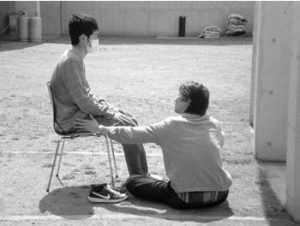
Figure 5: Hiro working with a high school boy in Miyagi after the 2011 tsunami/ earthquake
We might imagine our bodies as a second placenta, and thus we are intimately connected within the womb of our surroundings. Yield is an essential action for coming into relationship with the ever-shifting tempos, rhythms, and tumultuous or peaceful events of our lives and our world.
Carol Agneessens is a Certified Advanced Rolfer and Rolf Movement Instructor and also offers trainings in biodynamic craniosacral therapy. She is the author of The Fabric of Wholeness (2001) and is currently writing “The Embryonic Universe: Traversing the Primal Thread.” She lives on the Monterey Bay in Aptos, California. She can be contacted at [email protected].
Hiro Tahata is a Certified Advanced Rolfer and Rolf Movement Instructor living in Tokyo. He worked as a research biochemist at the Hayashibara Biochemical Laboratories for nine years where he studied megakaryocyte potentiating activity. He can be contacted at [email protected]. Carol and Hiro will offer a five-day workshop “Interoception: The Primordial Roots of Sensation, Tonus, and Gesture in Boulder, Colorado in August 2012.
Endnotes
14 See also the Water Cube constructed for the Beijing Olympics for more expressive images.
15 An example of this is the resonant undulation that developed in the original 1940 Tacoma Narrows Bridge (a suspension bridge, or tensegrity structure) when high winds provided an input that synchronized to the natural frequency of the bridge; see the archival video at http://www.youtube. com/watch?v=j-zczJXSxnw.
Yielding[:]