
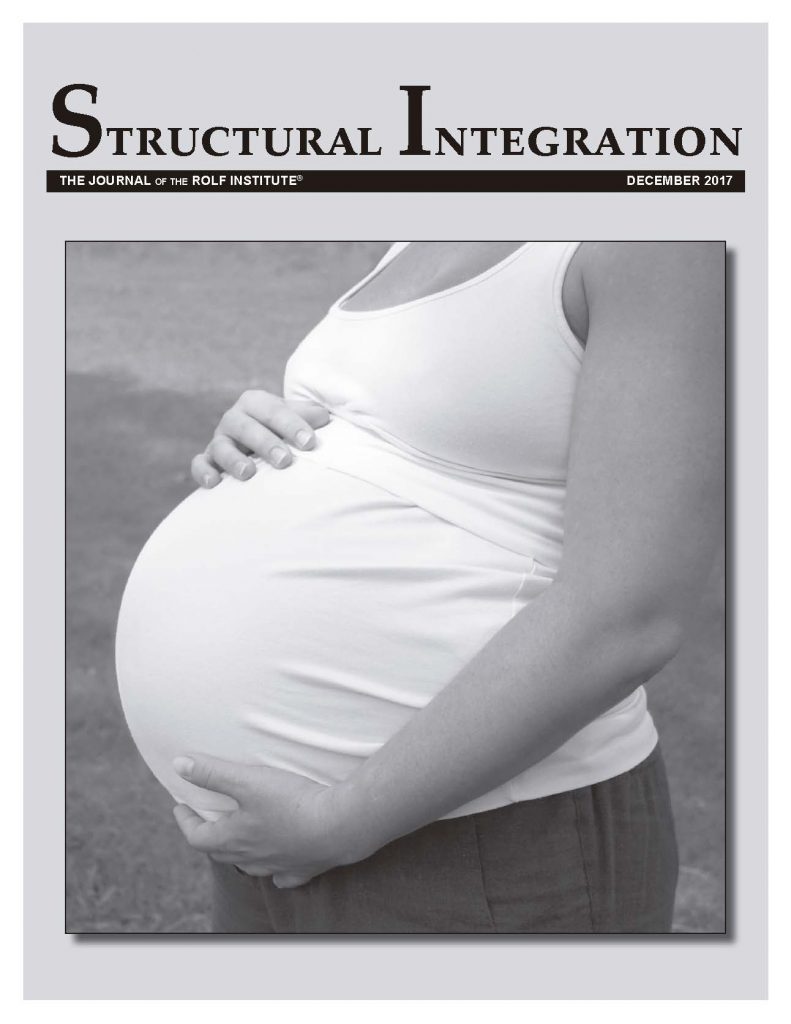

By Szaja Gottlieb, Certified Advanced Rolfer™
I had heard stories from colleagues – clients who had difficulties getting pregnant experienced success conceiving after going through Rolfing® Structural Integration (SI). There was even a paper I had come across citing anecdotal evidence theorizing that the change in the position of the pelvis aided fertilization. Around 2008 I had two female clients who, prior to receiving a Ten Series, mentioned that they were trying to get pregnant but were having difficulties. I cited the anecdotal evidence in a nonchalant way without really expecting to help. Interestingly, both clients had cases of moderate scoliosis. I began the Series with one of the clients in October of that year, and it was in December, around the holiday period, when she entered my office and pointed her finger at me, saying, “You made me pregnant.” Without skipping a beat, I replied, “I really don’t remember.” In both cases, the husbands called, enthusiastically thanking me, and even came in for sessions. Both are still my clients and come in regularly.
Szaja Gottlieb is a Certified Advanced Rolfer living and working in San Luis Obispo, California.
The Rolfing® Process and My Recovery from Pregnancy
By Mélanie Holt, Certified Advanced Rolfer™
Rolfing SI has helped me through challenging pregnancies and postpartum trauma and illness and continues to be a big factor in my recovery. From individual sessions and continuing education classes, I have uncovered more pregnancy-related issues than I imagined I had. Addressing those issues has made me feel better, but also helped me become a better practitioner. I believe that every challenge life throws at me makes me a better Rolfer.
In 2011, my first pregnancy was easy. At around five months I had a little bit of back achiness and was happy to get a Rolfing session from my friend Luca, and that was the end of it. Even one week overdue, still exercising and in 95-degree heat, no problem. Despite what everybody told me, I didn’t have an easy delivery, and I still pushed for three hours! Then my placenta would not come out and I hemorrhaged. I was going into shock when they finally took me to the operating room. I had an emergency D&C, a blood transfusion, spent the night in the intensive care unit, and twenty-four hours later I was reunited with my hungry baby and forgot all about it. Several months after giving birth, I learned that the thing in my abdomen that didn’t feel quite right during my pregnancy was a diastasis recti. It has become my arch nemesis . . . I did crunches every night for months on end, following some advice I found online, to get rid of my diastasis. I can’t say it was working, but it didn’t matter; in 2013 I was pregnant again.
That second pregnancy was very different. I couldn’t do anything. Even going on a walk induced light bleeding. I could work (I was living in the middle of nowhere in Southern Oregon, so I was less than part-time) and do whatever needed to happen in the house, but not much more. I was huge and uncomfortable; the baby’s head was up and would not turn. My ribs were killing me. Then I got sick at thirty-two weeks. I had a fever, lost my voice, and had horrible reflux. I coughed so much I tore something in my abdominal muscles. I think I cried every time I coughed after that.
Then at thirty-four weeks I went into labor. They took my son out via emergency C-section. He was almost dead and subsequently spent a month in the neonatal intensive care unit. I wasn’t thinking about my recovery or my body; I was an afterthought to myself. I was pumping every three hours around the clock to feed him milk through the feeding tube. Five days after he was released from the hospital, I was diagnosed with cancer. After two life-threatening hemorrhages, and a no-less life-threatening sepsis, I cruised through sixteen weeks of chemo. During my treatment, I received a couple of visceral manipulation sessions from Jeff Ryder. I was also bringing my infant son to be treated, since he had horrible reflux too. I started working again two months after the end of chemo. Retrospectively, these were definitely not my best sessions as a Rolfer.
About six months after the end of chemo, I received a three-session series. I was ten or eleven months postpartum and had been bedridden for five months; I was recovering from the port surgery and dealing with the emotional toll. After the series, I felt good enough and left it at that. I could exercise and run for an hour. In December 2015 I took Lael Keen’s Rolfing SI and Trauma workshop. She helped my healing when she did a demo on me that I fully credit for un-freezing my ovaries and getting me out of the chemo-induced menopause I was in.
The following year was full of ups and downs and I felt like I was reaching the limits of what my body could do way too early. Then in December 2016, I took a Mary Bond workshop. And wow. I think I finally had a glimpse of how much I had been ignoring my trauma and my body. I started to reconnect with my body at a deeper level. In January 2017, I started my Advanced Rolfing Training in Portland. That was the most Rolfing work I’d had in years. It was also the beginning of a long-overdue journey into self-care. I started Pilates this spring, and the compounding effect of Pilates and Rolfing work has allowed me to reclaim my body; I feel like my body is mine and not some old woman’s body.
My son turned three in April and my daughter five in May, and I can say I am just now recovering from my pregnancies. But they are so intertwined with trauma and sickness that it’s probably a little out of the ordinary. After my daughter was born I had decided not to use her as a guinea pig to practice Rolfing work with babies (which I had always loved to do). And she was perfect anyway. And I stuck to it. Now she loves to have her back rubbed and sometimes will ask me to “do the thing I do.” She knows the difference in touch, and she can express what she wants or not.
My son still has high needs, and some physical ‘stuff’ going on. His sacrum seems to rotate, his feet took turns being problematic. He used to trip on his left foot when he was just learning to walk. Lately his right foot was pronating so badly it pushed his big toe toenail in the skin, but with a mix of Rolfing work and chiropractic, and a growth spurt, he seems to be better. I am not the one giving him Rolfing sessions though. I can rub his back, massage him all I want, and he’s happy with it. But if I change my intention from nice rub to Rolfing touch, he pushes me away and sometimes starts screaming. He can feel the difference in my touch so much it’s incredible. He has more tolerance for other practitioners, as long as they’re quick!
Mélanie Holt is a Certified Advanced Rolfer with a practice in Portland, Oregon. She grew up in France under the influence of truly holistic osteopaths. After a fun but useless BA in English literature and translation, she moved to the Alps to surrender to her love of the mountains. Life and love brought her to the US in 2006, where she discovered Rolfing SI and was finally given a chance to do something meaningful. She believes in the transformational power of SI and is dedicated to helping her clients discover how they can become who they want to be.

Mélanie Holt with her children Adèle and Elliott
About a Postpartum Client
By Deborah Weidhaas, Certified Advanced Rolfer, Rolf Movement® Practitioner
A client had been through the basic Rolfing process with me and came back for a tune-up about fifteen months after giving birth. I was very surprised with what my hands experienced when they touched her belly, because I hadn’t noticed it before. The right side of her belly (costal arch to pubic bone, surface to deep) was very taut, and the left side was slack. As I worked, I stayed in a high state of curiosity in order to perceive what was going on; to sense where the whole belly needed my assistance in order to find integrity and become coherent, and to provide what it needed. After about twenty minutes, I shared a bit with the client of what I was doing and why. Then she told me more of the story. The delivery of her child had been long and painful, including being placed on a table that was painful to lay on; yet, she was on it for a couple of hours. The nurses were frustrated with how long her delivery process was taking and, because of this, one nurse pushed with her own hands and body weight into my client’s left belly and kept pushing, farther and farther, for a long time, in an attempt to make the baby come out. “Well,” I thought, “now I completely understand why the left belly is slack and the right belly is hyper-activated.” My sole approach in this session was to work with the entire belly as scar tissue. My client and I are indebted to Sharon Wheeler’s scar-tissue workshop for the results. By the end of the session, the whole belly had integrity and was coherent, with both sides participating equally in structure and function. My client had a peaceful, yet energized, smile on her face. The shift in structural vitality was obvious.
Deborah Weidhaas is a Certified Advanced Rolfer and Rolf Movement Practitioner, recently relocated from California to Richmond, Virginia.
Motherhood and Being a Rolfer
By Lina Hack, BSc, BA, Certified Advanced Rolfer, Somatic Experiencing® Practitioner
My first week of being a professional Rolfer in my first downtown office was timed perfectly to match the release of my article about Rolfing SI in the local wellness magazine. To my pleasant surprise, the phone rang the first day the article was out, and by the end of the week I had a full month of work. As clients called I would make myself available to them at any time: during the workday – yes, no problem; evening – yes, no problem; and weekends – yes, no problem. My professional life rolled along with full abundance for four years.
I was so excited when I finally became pregnant because it took some effort! During sessions however, I held back from telling my clients, despite my heart wanting to declare my happiness to them. Announcing a pregnancy would naturally follow with questions and presumptions that I needed time to consider.
I’ll never forget how, during a session, a male client of mine asked, “So when are you due?” We looked at each other with shock. I was only weeks into the pregnancy and I thought he was commenting on my size. He said, “Didn’t you just tell me you were pregnant?” I didn’t think I had said anything; I had, however, been telling myself repeatedly to be quiet about it. After that experience, I realized how intuitive my clients were and I slowly started to mention my growing family.
I was able to hold onto my strength as a Rolfer well into my eighth month of pregnancy. There was a distinct and anticipated moment, however, when it was clear that I was the client, the very pregnant client, and I was not able to be the practitioner for a window of time. The birth of both of my babies was a peak experience of self-actualization. Yet this was paired with sadness for pausing my Rolfing practice in order to focus on being a grounded mom for my little ones.
Motherhood has been a welcomed benchmark for me and I took all the time I needed to establish balance with a healthy growing little one before I returned to my practice. I took eighteen months away after the birth of my first child before I started seeing clients again. I took two years with the second babe.
What a humbling experience to put a full stop to my Rolfing practice twice, and then cold call former clients, asking for their interest to shine again on my work. I put effort into my community, my yoga-instructor friends and massage therapist friends, letting them know “The Rolfer is back to work after having her baby . . .” and generally getting myself out and about to remake those professional contacts. This was incredibly humbling because many clients booked without hesitation and we picked up our structural work where we left off. Some clients had moved. Some had moved on. Each story with each client felt deep, like motherhood had softened and deepened how I experienced all my bonds with people, even the professional bonds.
I must sing the praises of the continuing-education classes that our Rolfing faculty and colleagues are offering all the time. For us parents who step back to create new human beings, it is wise to get ourselves back into the big tent of Rolfing SI by getting back into classes. To my great benefit, an Advanced Rolfing Training launched near my house three months after I returned to work after my second babe. It was just the updating of my files that I needed. My internal narrative quickly became confident with my maturity and life experience. The Advanced Training initiated a new wave of professional momentum that can only come with time in the session room with clients.
Yet once back in my session room, I wasn’t able to be the ‘available-at-any-time-Rolfer’ I had been before. There was an intricate puzzle of pieces that had to be put together to allow me to be in my office for a few hours: childcare, school hours, lunches made, and grandma on standby. And I now can really only offer my work during standard work hours – no more evenings, no more Saturdays. It is true to say new clients, who often wish to have their Rolfing sessions after work and after the workweek, can find my time restrictions a disappointment. I keep my humble heart firmly planted on the earth and explain, “I’m a mom with small children and at this time I have limited hours. Hopefully our schedules can overlap to have our meeting.” And you know what? People find a way to make their schedule fit a Rolfing session when the Rolfer is available.
Lina Hack has been a Rolfer in Saskatoon, Saskatchewan, Canada since 2004.
A Collection of Pregnancy-related Experiences
By Patty Murphy, Certified Advanced Rolfer™
The Pelvic Floor and Postpartum Body Awareness
In the Rolfing® Structural Integration (SI) training, you learn a lot about your own body. I felt like I was so in tune with my body by the end of it, I knew how to use and connect through my body, I knew how to connect through my pelvic floor. Going through my pregnancy was not a problem, and I believe that having all that body awareness and knowledge of body mechanics made working through pregnancy easy. I worked up until about two weeks before I had my son Liam. It was afterwards that I found trouble bouncing back.
Giving birth to my son was a traumatic experience and postpartum experience didn’t get much easier. I was induced at about one in the morning after my water had been leaking slowly for well over twenty-four hours. After about twenty-one-and-a-half hours of slow labor, my son finally arrived but was not breathing. They got him breathing fairly quickly, and it seemed we were in the clear. Then at about seven the next morning, they came to tell me that his bacterial levels were high and they would have to take him down to the neonatal intensive-care unit (NICU). I followed my son and moved myself into the NICU also, sleeping in a recliner for the next ten days. They poked and prodded him for a few days because his veins kept collapsing, until they finally decided to go through his umbilicus. He was supposed to come home after five days of antibiotics, but after two days they said his stomach was distended, he was lethargic and wouldn’t eat, and his intestines were completely backed up. On day four he tested positive for Hirschsprung’s disease; Liam was born with no ganglion cells at the end of his colon. On day eight they did surgery to remove about six inches of his colon, opening up around the anus, and pulling through until they found nerves, and then reattaching it at the anus. Those were some of the most trying days of my life.
Two days after the surgery, they finally sent us home. Then began the journey of trying to figure out life with a newborn. You spend your days and nights sitting, nursing, and carrying around this adorable screaming baby with little sleep and no time to think about anything other than being tired and what the baby needs next. That might be seem a little dramatic, but you really don’t have time to think about yourself, or what you or your body needs, or even realize that your whole sense of self has changed – or in my case seemed to have disappeared.
Looking back now, I don’t think I even noticed I was that far removed from myself until about six months later. It took about a year before I started finding my body again and feeling like myself again. Things started to shrink back into place. As the baby got a little bit older, I had a little more time for myself, and it was then that I started to have more body awareness. And it was also then that I realized I could not connect with my pelvic floor. My pelvic floor had up and left me, or at least that’s how it felt. Something that was so obvious to me before was nonexistent.
So how did this affect my work? Since having my son, I have found it hard to walk clients thought certain movements and teach them how to make certain connections, like how to settle in the pelvis. It is hard to show others when you don’t know how to make the connection yourself. A lot of the movement work we were taught was lost to me, because I couldn’t find it in my own body.
I attended Advanced Rolfing Training when Liam was about a year and a half, and that is where I finally found a fighting chance at getting back what I had lost. During a session with my practitioner, instructor Jan Sultan came over and did pelvic floor work with me. It felt different from what I had been taught initially in my training. As opposed to just going on the edge of the pubic ramus, he used his forearm to sink well past that, and for the first time in over a year, my pelvic floor began to open. That made a huge difference, but wasn’t the only change. During the next session, we found that my pubic symphysis was off, and Jan reset it. During pregnancy, with all the hormones, especially the relaxin, ligaments relax and allow the pelvis to open more easily. The pubis spreads to make way for the baby coming through the canal, but mine didn’t come back correctly. Having that bit of pressure relieved, I felt that one day I would be able to not only connect to, but strengthen my pelvic floor again.
Pregnancy, but mostly postpartum, was a big learning experience for me, both as a woman and new mom and as a practitioner. I learned that you get some of your body back, but you don’t get the same body back. I don’t how many people really consider that aspect of it. I expected to be heavier, I expected things to be looser, but I still expected to know where my body was in space. My son is three now, and I’m still discovering this new body, and only recently have gotten the strength back in my pelvic floor. It was a long progress, but every time I look at my son, I know it was worth it. Now in my second pregnancy, I have a better understanding of what to expect.
Working with Pregnant Women
Since my pregnancy, I’ve been amazed at how many clients have walked through my door pregnant. Most of the work I do with women who are expecting is simply getting them comfortable in their ever-changing bodies, as any preexisting imbalances seem to be exacerbated during pregnancy. In the very early stages of pregnancy the work may not look much different, but you need to be mindful of positioning and keeping them comfortable. I carried small in the beginning of my first pregnancy and was able to lay on my stomach longer than others, especially compared to second- or third-time moms, but even I had my limits.
I work to stabilize the pelvis and ease restrictions, resetting them each time, and being really mindful as the joints are more relaxed due to the hormones released during pregnancy. During the later stages of pregnancy, along with keeping the pelvis balanced, it is important to create room through the rib cage. As we lose the abdominal muscles, we get short in the back. Working to open the back and bring some of the tissue forward gives the ribs the ability to move, and can make all the difference in the world for an expecting mom.

Patty Murphy and her son Liam
During the first trimester of my first pregnancy, I received work from an SI practitioner, and I could tell he was very uncomfortable working with a pregnant woman. Having been through pregnancy myself now, I realize that a pregnant woman is not that fragile, and the work can make an important difference to her ever-changing body. When working with a client during pregnancy, it is important to be more attentive to positioning so that she is comfortable on the table. Be more mindful of how things are moving, and take a moment to recheck more frequently; make little movements, check, little movements, check again. That might not include having the client stand up, because if she’s farther along in her pregnancy, getting up and down can be hard. It is also important to check in with the sacrum and consider how her system is integrating the work. Communication is essential during sessions. What a person’s ‘normal’ is can change from day to day. Some days a pregnant woman can be exhausted, while other days, she’s fine. Continue to check in with the client and modify your work as needed.
Working with Postpartum Women
Postpartum work was my steepest learning curve. In early postpartum work, you need to have some of the same considerations as with pregnancy when it comes to work around joints, since some of the hormones may still be present in the body, especially in moms who are breastfeeding. As I learned in my own journey, it is important to get the pelvis rebalanced and to bring more awareness to the pelvic floor and to have her try to connect with it.
There are some different considerations with C-sections versus a vaginal birth. Having a C-section may not result in losing your pelvic floor, but you can lose the use of your abdominal muscles and your core. Working to naturalize some of the scar tissue and working viscerally is important not long after the new mom has healed. I believe that we as practitioners are more aware of the imbalances that come from a C-section, but we often overlook the imbalances that can happen during vaginal childbirth; at least that was the case for me.
There are also upper-body issues for women with a baby in arms, particularly with breastfeeding. More than the shoulders, the issue is the head drop. You spend so much time with your head tilted, staring down at the child. If the baby’s sleeping with you (co-sleeping), you’ve always got the baby on your arm and you don’t actually fall asleep as well or sleep as deeply. Another issue with postpartum women is that they are exhausted! While she is receiving work, her system only has so much resource to shift. That’s why it was about a year after delivery before I started to at least figure out that I had a body again. It’s about that long before you get a chance to breathe again and when the baby finally sleeps through the night. For my son Liam it was over a year before he started sleeping through the night.
Patty Murphy has been practicing for ten years and has recently opened her own wellness center in Patchogue, Long Island, New York. She practices full-time while balancing life with a three-year-old and preparing for a new arrival in February.A Compilation of Stories on Pregnancy, Postpartum Issues, and Balancing Motherhood with a Rolfing® Practice