The first contact in my office with any prospective client, male or female, is a full-hour consultation. I spend an hour (and charge for the time), which allows me to get a complete history and start ‘connecting the dots’ in the client’s history. I also get out the anatomy book, show pictures of fascia, and explain the logic of the Ten Series. People are intelligent, and when they understand that a comprehensive change will give them more than just working where it hurts, they tend to stay through the Series to enjoy the full benefit that is available. So my approach is about working with the person, and I don’t think of working with ‘the female body’, but that initial interview will usually surface elements of personal history that are unique to that person’s gender.
Training in The Feldenkrais Method® of somatic education has added a great deal to my understanding of developmental movement, and how it shows up in infants, children, and adults. A child learns a movement, and stops developing that movement not when it’s ideal, but when it will suffice to get to the next stage of developmental movement. It is possible to make that movement more ideal at any stage of life, hence the importance of continuing to discover and use self-awareness.
Developmental movement becomes structure. Whether a pattern is acquired in infancy and first years of life, or through habitual use, injury, or any other necessity later in life, every structure is a result of repeating forces that develop their own harmony with gravitational forces. Fascia is a slow-moving river, with swirls and eddies that are evident in structure, and can be detected as we move.
One example is a woman who was a track athlete; hurdles was her event. I always ask, “Which leg did you use to push off, and which went over the hurdle first?” This will give me a picture of how that particular repetitive use is embedded in her structure. The push off foot, the reach through other leg, the follow through with the push-off foot, now with knee forward, the landing on the forward foot – those forces all drive into her pelvis while it is still twisting. Unwinding that pattern will be more successful if we take those moving patterns into consideration. As Ida Rolf asked – how did that pattern get there?
Later she is in the office, with children who are two, five, and seven years old. The pregnancies, carrying babies (usually on one hip), other daily home and work activities, perhaps working at a computer several hours a day, will have created other patterns that are overlaid on the original hurdling movements. Differentiation and integration will first involve following the more superficial pattern through her feet/legs and pelvis into her torso, arms, and neck.
In the eighth session, today, she reported still having pain in her right leg, hip, pelvis, and low back. During the session, in sidelying position, I tilted first her knee, then her ankle, toward the ceiling. It was much easier for her femur to go into internal rotation with the ankle toward the ceiling. Using indirect technique combined with movement, I took the myofascial structures further into the internal femoral rotation. Then in supine position I worked with her lower leg, which more easily went into external rotation. Work in her right iliopsoas relieved more of the pattern (this is her landing foot). During the back work on the bench, much more density was evident on the right, and so more focus went to that area. She experienced more relief, and an absence of pain, than had occurred in the first seven sessions.
Differentiation of layers has to be done with care, allowing a woman to sense what is happening and have the opportunity to participate. As you allow her to be in charge of the pacing, she will be more able to explore deeper connections. In those layers will also live her personal and family history, and many other life experiences that may have never been really consciously articulated at the time they ‘grew into and with’ those layers of fascial structure. Allowing her to determine the pace of unfolding will allow you as the practitioner to go more fully into the patterns. As you can allow the process to evolve in every moment of the work, you can have trust and partnership, emotionally as well as physically. Comprehensive and coordinated interventions become the dance that spirals in the same directions that evolved to create the patterns.
Women will also frequently see the usefulness of the work for one or more of their children. I have worked with a woman who has one child with a previous hard fall onto concrete when he was five. He was having physical issues that none of her other six children has had, including migraines. In the course of working with him, now age eleven, it has become clear that there is a very significant rotation in his spine and pelvis. Whether it came from a fall or from other experiences, I do not know. I was able to help him become aware that he can turn to the left, but not to the right. Besides the obvious structural restrictions, I worked with his head to see where movement was easy or restricted. I also checked his torso by lifting under each shoulder, one at a time. His pelvis, with similar lifting to test, will only rotate in the opposite direction. There are no x-rays, so I don’t know if there is a clinically diagnosable scoliosis. But the pattern, as it presents itself, leads to the appropriate interventional strategies. I also checked his eyes, and noticed that he appears to see with only one eye at a time, which would significantly change his organization so that eye would be more in the center of his field of vision. That has to be accounted for in the work, since that kind of organization can’t be changed. His mother can take him for visual-field tests if this pattern persists. So far, he is curious, accepting of work, and I am trying to ask for significant change, but not too much too fast. His mother is always in the room. They share a connection that I am happy to accommodate. I try to be careful to allow any and all relatedness between the two, and not intrude on that in any way. All the time, I am listening with my hands and sensing with myself to see, hear, and sense what is going on in his system. His mother is seeing change, and he is also seeing change and staying engaged. This is integrating for both of them.
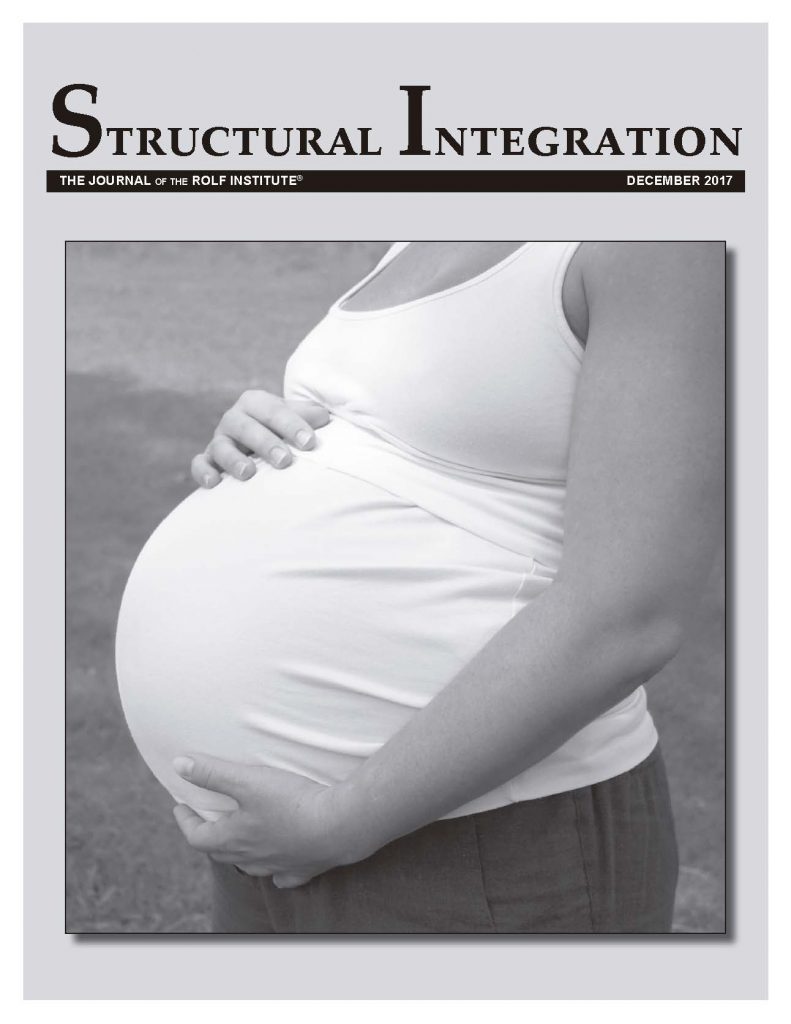
There are situations unique to the female body. Work during pregnancy helps provide support and relief. Generally, more superficial work is appropriate. Since miscarriage occurs in about 25% of pregnancies within the first trimester, I do not work with clients until they are in the fourth month. By this time, a woman is beginning to feel the increased weight of the baby and relaxation of ligaments altering her structure and movement. Easing superficial structures in her feet and legs, lateral ribs and diaphragm area, neck / shoulder girdle / arms gives her a place to rest and more fully accommodate the changes.
Postpartum work in the pelvis helps a woman to reclaim her body. It will never be the same as it was prior to pregnancy, but can feel a lot more familiar, much more quickly, with structural and movement interventions. The uterus has regained a more normal size by about eight weeks, so work directly in the psoas/iliacus, and relationship into legs/feet and spine/ribs/ neck, is possible and helpful to integrate her structure into something that she can recognize and rely on.
Of particular importance with working with women and children is the possibility that there may be history of abuse and/or trauma. Sometimes this history occurred at a preverbal age, and she does not have vocabulary to articulate the experience or feelings. This can feel very confusing, and may trigger a reaction to stop the feelings. I never try to act as therapist: even if I were a therapist, I am not that client’s therapist, and that is not part of the contract. There are, however, ways to engage a woman in allowing the feelings, even if she needs to hear that it is okay to wait until she feels she is in a safe place (such as home or with a trusted therapist or friend) before allowing them fully. This gives her some space to avoid shutting down and allows for full expression at a later time.
Emotion is movement – e-motion. It is always moving, however fast or glacially. When I am aware of my own state, and listening to the other, I am able to work with the tide, so to speak, and that allows both differentiation and integration to flow. Both can be happening at once, if the pacing is appropriate. Another aspect of movement is its role in creating, and maintaining, the structure we see. Movement is happening in many rivers, streams, and eddies in everyone. Daniel Siegel described consciousness as having parallel, simultaneous streams. Our being, and its expression through movement and structure, is consciousness. We are working with “what we can get our hands on” – to paraphrase Ida Rolf. And we are working with the person who owns those hands – ourselves. It is in this dance that the magic of the session happens. And the longer we practice, and the more we continue our education within and outside of strictly structural work, the more we move into this stream and dance with the other’s structure and being. It is, in my experience, what integration is about.
Libby Eason was first introduced to Rolfing SI in 1975. She was immediately impressed by the transformation in physical structure. In 1992, Libby graduated from The Rolf Institute® of Structural Integration (RISI). She completed her Rolf Movement training in 1994 and Advanced Rolfing Training in 1997. She began training to be an instructor in 1998 and is a current faculty member with RISI. She completed the Feldenkrais training in August 2016. Libby has served as president of the Ida P. Rolf Research Foundation since April 2012. She is past president of the International Association of Structural Integrators®, and served on its board of directors for ten years.
To have full access to the content of this article you need to be registered on the site. Sign up or Register.