

The year was 1959. Dr. Rolf, in a “grandmother house with big flowers on the walls,” provided structural integration to brothers Tim and John Barrett (see Figure 1), ages five and seven. Dr. Rolf was working with Tim to help with issues caused by Legg-Perthes Syndrome; John was getting sessions “most probably so I wouldn’t feel left out.”
John remembers Dr. Rolf taking side-view pictures before and after the ten sessions. “She leaned us against the only part of her wall that was white.” The change in Tim’s structure was so dramatic that Dr. Rolf asked Mrs. Barrett’s permission to place Tim’s profile in her logo. “Dr. Rolf hired an artist to draw pictures based on Tim’s photographs, using blocks out of alignment for the ‘before’ picture and blocks in alignment for the ‘after’ picture.” The result became the Rolf Institute’s most enduring icon, The Little Boy Logo. In Figure 2 we see Tim some months before his death holding the logo poster. He took time out from his last family reunion at the house he built in Kalapana, Hawaii, to pose for this picture. He wanted everyone, especially carpenters with body issues, to know that Rolfing SI can free you from pain.
How It All Started
John and his wife Pam are my beloved neighbors. I asked John and his brother Tim if I could interview them when I learned about the connection between Tim and the Little Boy Logo. I was concerned that otherwise these first-hand accounts of a valuable piece of the Rolfing community’s history would be lost forever. Both heartily agreed: they wanted the world to know how grateful they were. Both John and Tim shared their memories of Dr. Rolf with me before Tim’s passing on July 6, 2017.
“My brother was diagnosed with Legg- Perthes Syndrome,” John told me. “We are Scotch-Irish. This syndrome is very common in Perthes, Scotland.” Tim’s impish humor is apparent in his next playful comment: “You get this from being with sheep. That shows you what kind of relatives we had.”
John remembers that “one of Tim’s legs was shorter than the other. He could ride a tricycle alright, but he had to stretch his arms out straight to keep his balance when he walked.” Tim recalls, “Doctors told my mother I needed to be in a body cast for years and would probably end up in a wheelchair soon anyway.”
Mrs. Barrett would have none of that. Fortunately, her friend Helen Spencer, who “accepted a lot of alternative ideas,” was acquainted with the work of Dr. Rolf. “We drove all the way from Manhattan Beach to Pasadena to meet her.”
“Tim and I knew her name was Ida Pauline, but even my mom always called her Dr. Rolf.” John put his hands together and rocked side to side, imitating her higher-pitched voice, “You must call me Dr. Rolf.” For a just a moment, I saw in John the seven-year-old Dr. Rolf had known. I couldn’t stop grinning.
Tim’s strongest memory of Dr. Rolf was of “a large lady chasing me around the swimming pool.” His only explanation as to why was, “I had a lot of energy, and so did she.”
Tim continued: “I only had ten sessions because that’s how many you’re supposed to have. The sessions were long but I never fell asleep. Dr. Rolf never got mad at me, but sometimes she would get mad at my hip. She’d grunt and her fingers would get really hot. Not too hot. Nothing really hurt – well it might have hurt a little – but I didn’t care; I knew she was going to make me better.”
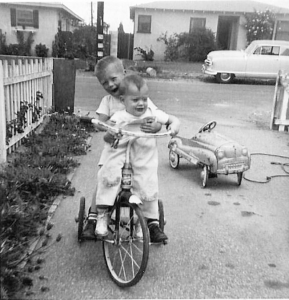
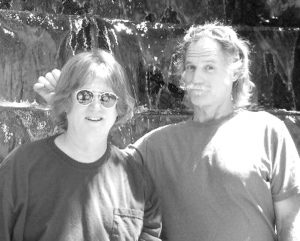
Figure 1: Tim and John as children and as adults. On left, Tim, age one, in front of John, age three, on a tricycle, Redondo Beach, CA, 1955. On right, John (L) and Tim (R) on a road trip to The Tree Circus, Gilroy, California, 2006.
“When she was done she would say, ‘Okay, that’s all for now,’ and you knew she was done. Really done. It was time to get off the table. Then she’d work on my brother. While I waited, I would just lie on the couch and rest, too exhausted to play with my toys or anything.”
John, being two years older, has more vivid memories of the house and sessions. “Dr. Rolf was an older lady when I met her. She lived in a bungalow-style house with stairs in the middle leading to a big front porch. The living room had a big table with a chandelier above it. I would sit at that table waiting for Tim. Dr. Rolf left papers and crayons so I could draw. The kitchen was off to one side and smelled like cookies. She had a special room filled with books set up for treatments. It looked like a library.” [Editor’s note: John assumed this was Rolf’s house. Rolfer™ Jan Sultan believes it was the house of one of her early students, perhaps Hadidja Fielding (Lamas).]
“Tim was able to walk so much better after each session – that’s because she elongated his muscles. I didn’t mind her working on me. It just kind of felt like massage or something. Well, maybe just a little more uncomfortable than that.”
John remembers a set of follow-up sessions they both had with Dorothy Weber, a student of Dr. Rolf’s. “It was about six months later, Dr. Rolf had to move on to another project. Dorothy would come to our home. She swam every day in the ocean near the Hermosa Beach pier to get her exercise. She was a nice lady and tried to act just like Dr. Rolf.”
Tim told me that he walked without any difficulty after completing the ten sessions. In addition, “Dr. Rolf took all my pain away. My leg gave me no problems until I was fifty-five” – at which point he received a hip replacement due to a deteriorating joint. “But I never felt any pain even then. All thanks to her.”
John agrees that Tim never appeared to be in pain after meeting with Dr. Rolf, but he remembers his brother walking with a pronounced limp. “His right leg was always shorter than his left so he’d push it forward using the ball of his foot.” Tim never used a cane or a wheelchair. “In third grade, they gave him a lift for his shoe; but he didn’t like it and refused to wear it after a week.” John was relieved to hear that Tim was never in pain. “I was never sure. He is not the complaining type; he’d rather suck things up.”
Tim also asserted that Dr. Rolf saved him from what could have been a life of substance abuse. “I knew so many people at work [other carpenters] whose bodies were in so much pain that they would use drugs and alcohol just to make it through the day. I never had to do that. Thanks to her I was able to support my family, myself and my children.”
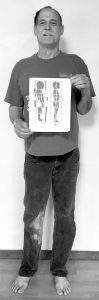
Figure 2: Tim holding the Little Boy Logo,
March 2017.
John introduced Tim to surfing when he was in the eighth grade. “I thought it would help him – be good for his joints. The water would buoy him up.” Tim took to it and became a smooth and powerful surfer (see Figure 3). The bigger the wave, the better. He never held back. “I am a happy man today – thanks to surfing and Dr. Rolf.” And carpentry.
Tim fell in love with working with wood in high school, thanks to the efforts of a talented shop teacher. He spent his adult life honing his carpentry skills and building his own houses. Tim had a message he wanted conveyed to the Rolfing community:
Rolfers, please let the unions know how much Rolfing [SI] can help carpenters. Their bodies can hurt so much, and drugs and doctors are not doing a thing for them. Thanks to Rolfing [SI], I was able to work harder, faster, longer than all of them. I want their bodies to feel as good as mine does.
Tim told me about his visit to the Rolf Institute in Boulder, Colorado for the 100-year celebration of Dr. Rolf’s birth. [Editor’s note: contemporaneous reportage and photos are in the August 1996 issue of Rolf Lines® (Vol. 24, No. 3), pages 54, 56, and 57.] “When they found out Dr. Rolf had worked on me, they all wanted to touch me. But I told them I didn’t have any money.” Tim declined sessions even after he was told there would be no charge. “Dr. Rolf did enough for me. I was still just fine.” However, a few years later he did avail himself of a few sessions with a Rolfer on Maui and found it extremely helpful, “She was just like Dr. Rolf all over again.”
Tim died this past summer at the age of sixty-three of a brain tumor. He told me weeks before he passed, “It’s okay. I’ve had a good life. I was deeply loved by my brother and children.”
John spent a week with him during his last days. Tim would take John’s hand repeatedly and make him promise that he’d take care of his children. John would reassure him and then rub Tim’s fuzzy chemo-head. “I just kept touching him and telling him how much I loved him. We talked on the phone daily. I miss him so much.”
Tim is survived by his children Keone, Jasmine, and Nalu, and grandchildren Harper and Jackson, who were the light of his life. Jasmine told me that “when I called to tell him I was pregnant, he couldn’t stop screaming.” His ashes are scattered on both sides of Hawaii’s Big Island at two of his favorite surfing haunts.
Tim’s last name was changed to Law when he was adopted by his stepfather at the age of nine. Dr. Rolf would have known Tim as “Tim Barrett”; the Rolfing community at Tim’s later visit would know him as “Tim Law.” John, who was older, chose to keep Barrett as his last name.
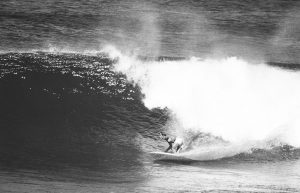
Figure 3: Tim surfing in Maui, November 1977. Photo by Dana Edmonds, used with permission.
Jan Marie Alarcon, PhD, is a licensed clinical psychologist and freelance writer. She received her PhD in clinical psychology from Rosemead School of Psychology in 1991 and specialized in treatment to marginalized and underserved populations. Dr. Alarcon met John Barrett the first week she moved into Shandon, California – population 1,230, the land of affordable housing – in 2003. John gave Dr. Alarcon a jump when her battery died in a church parking lot. Pam, John’s wife, noticed the Little Boy Logo on the back of a book Dr. Alarcon was reading (Ida Rolf Talks, edited by Rosemary Feitis) and exclaimed, “That’s my brother-in-law; really truly, that is my brother-in-law.” Dr. Alarcon is recovering from a major car accident that resulted in numerous broken bones. SI sessions have helped her walk with more ease and regain feeling in her right foot.
Endnote from the Editor-in-Chief
The exact details of the story of the Little Boy Logo used by Rolfers are shrouded in the mists of time. Most of the adults from that time – who might remember definitively – are no longer with us. This version of the story comes from two people who were there, but they were young children and perhaps not cognizant of all that went on. Particularly, we have here some variations from the account Linda Grace wrote on her blog, “Rolfing® Structure and Movement Talk” (rolfinggrace.com). Some we can parse out; others we cannot.
In her blog post (www.rolfinggrace. com/2010/07/the-story-of-the-rolfing®-logo/), Grace relayed information she heard by old-time Rolfer Dorothy Nolte present at a Rolf Institute membership conference in the 1980. Based on this, Grace named Nolte as Tim Barrett’s aunt and the connection to Dr. Rolf. Upon my query, John Barrett relayed through Jan Alarcon (personal communications, 10/10/2017 and 10/11/2017) that Nolte was not an aunt, but rather was the first wife of Durwood Law. Mrs. Barrett, mother to Tim and John, later became the second wife of Durwood Law, thus Tim having his last name changed to Law. Alarcon says John believed that Dorothy Nolte was not part of the decision to go to Dr. Rolf, but she comments that it just may not be part of the story as he knows it.
Other differences are that Grace relates that the work on Tim Barrett was done in a classroom setting, while Tim and John remember it being done in a private residence and offer vivid details on the décor and events. Here, it seems appropriate to trust the firsthand memories of the children.
Grace also says that Rolfer John Lodge did the drawing of the Little Boy Logo. According to Grace (personal communication), Lodge in 1983 claimed the drawing was done at Rolf’s behest after a first session done in a class. The Barrett children do not remember a class, and only remember that permission was asked for an image to be created. As these recollections by all parties were given some decades after the event in 1959, we are again facing the obscuring ‘mists of time’.