

By Naomi Wynter-Vincent, PhD, Certified Advanced Rolfer™, Rolf Movement® Practitioner
ABSTRACT Rolfers do manual work on and in the nose in the Seventh Hour of the Ten Series. This article reflects on those protocols as well as the implications of COVID-19 precautions. The author explores the idea of nasal intelligence and the role smell has with body awareness, intuition, and orientation. The nose and breathing are coupled, which is touched on as having complexity that is anatomic and social.
Somewhere inside the head is the ‘rhinencephalon’ – the nose-brain. Why is that? Do our noses think? Have our noses got brains? Why did the early anatomists call it the ‘rhinencephalon’? Where did they get that idea from?
R. Bion (2014, vol. 8, 157)
Intranasal Rolfing Structural Integration (SI) is, without question, one of the more surprising and sometimes challenging parts of our work. The challenge may, of course, be on both sides of the client- practitioner line: we may be nervous or reluctant to give the work, and some of our clients are undoubtedly nervous to receive it. (I’ve never had a client refuse the mouth work, but two clients have asked not to receive the nose work.) My own initial Ten Series did not include any internal work, so it came as a surprise when I got to the pre-training. I remember having a slight head-cold when I first received the work – something that is now unthinkable in these times of COVID-19. As I think about being able to resume work (here in the UK we are back in strict lockdown at the time of writing and likely to remain so for some time to come), I wonder and worry a little about the strange but very interesting work that we do most often as part of a session seven. Will clients become more wary of receiving work in the nose (or mouth), for fear of infection? Will we be wary of catching an infection from our clients while working intimately at these particular sites? How can we continue to integrate the nose into our work, into our clients’ self-perception and awareness, without working (inside) the nose directly?
I chose to open this piece with a quotation from the British psychoanalyst, Wilfred Bion (1897-1979). Bion trained initially as a medical doctor, and he was fascinated by the experiential interfaces between conventional modern anatomy and those vestigial, archaic, or embryological aspects of anatomy that find no place in anatomy textbooks but nevertheless leave their traces, either developmentally within the individual, or within the cultural imaginary of our species. The rhinencephalon, or nose-brain, is a bit of descriptive anatomy that has a long history as an idea but no longer really has an anatomical reference, at least in human beings. It can refer to the nose itself, but also to those parts of the brain involved in olfactory processing, and everything in between. What I am interested in exploring is the idea of an imagined part of anatomy that can nevertheless stimulate or orient our work as Rolfers, and particularly during this period where we are more than usually reliant on the imagined or imaginary aspect of our work. I want to be clear: by ‘imaginary’ I do not mean (or do not simply mean) ‘not real’. The rhinencephalon is not ‘fake news’; the rhinencephalon can be a creative resource allowing us to explore the idea of our nasal intelligence and to think about how Rolfing SI might help our clients to enrich their nasal awareness, nasal intuition, and nasal orientation. This is work that has more in common with Rolf Movement work, perhaps, than the more direct or ostensibly ‘structural’ nasal work of a typical session seven. But it is not exactly obvious movement work either. Unless you’re Samantha Stevens – the character played by Elizabeth Montgomery in the 1960s US comedy television series Bewitched – and have perfected a wicked nose-twitch, the nose doesn’t really move, itself, all that much.
Rather, the role of the nose in movement is more that it moves you: towards or away from pleasant or unpleasant stimuli, or moving the air that passes through the nose in and out of the body. As such, the nose has a powerful orienting function
and forms an important bridge between our inner and outer worlds. In this time of COVID-19, it is also our first defense against (or the open door to) the novel coronavirus. In the new world that we are learning to inhabit, the nose is suddenly more prominent in our conversations. Scientists now tell us that the chief route of coronavirus transmission is not via unwashed hands (or unwiped groceries!) so much as through aerosols: that is, through the minute droplets expelled through normal breathing that may contain the virus. Aerosol is very literally the air we breathe, the atmosphere between two or more people, and we are having to learn to think of it as always potentially unsafe. The spaces between (you and me, you and the other), the spaces inside and outside, are now fraught and freighted with invisible, incalculable risk. Of course, there were always colds and flus – none of this is actually new – but our awareness of risk is definitely heightened as a result of our collective experience of 2020, and the nose is at the epicenter.
We also now know that COVID-19 targets our ‘nose brain’ in another way:
anosmia (the loss of the sense of smell), even without obvious blockedness or stuffiness of the sinuses, is a recognized symptom. Though blessedly usually temporary, we should acknowledge that COVID-19 potentially disables a part of our nervous system, a part of our intelligence. In his very interesting article, The Smells of Fascia: Rolfing and Intuitive Olfaction, Ray Bishop (2000) discussed the way that he could sometimes track clients’ process through his own, powerfully intuitive sense of smell, noticing the overpowering odor of anesthetic while giving a session five, for example, or a distinctive smell of burning while working on a client who, it later emerged in her therapy, had witnessed a tragic scene of someone burning when she was very young. While losing our ability to smell might save us from some odors we’d rather not be aware of, it also blunts a very primitive, early aspect of our intelligence that centers on detecting threat and recognizing safety.
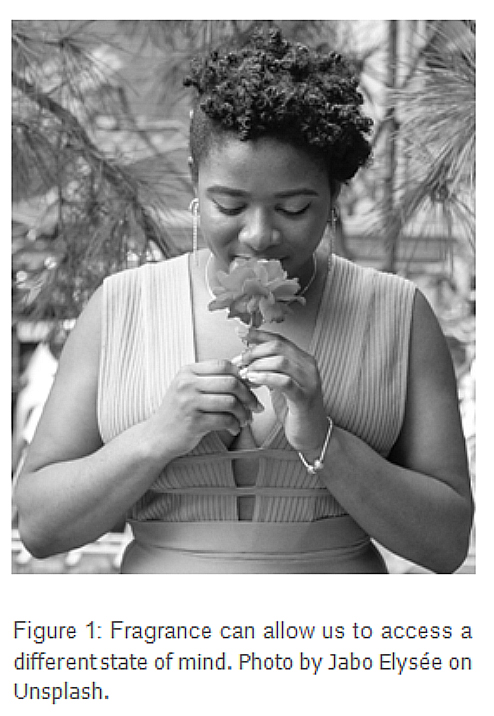
Odor and fragrance play an especially important part in the life of the rhinencephalon (see Figure 1). When Proust’s narrator in In Search of Lost Time tastes the madeleine dipped in lime- flower tea, he almost certainly smells it too, and a part of his memorable account of the sudden unlocking of memory is undoubtedly attributable to the nose-brain. Fragrance and odor alert us, remind us, create a literal atmosphere that can enable us to access parts of our mind that are otherwise inaccessible. For example, I am thinking about the way that many different religious traditions call on incense as a part of prayer or meditation (not only to mask the unpleasant whiffs of congregations of old), the role of aromatherapy (both as art and science), and perfume. During lockdown in spring 2020, I spent several evenings testing fragrance samplers from a favorite perfumer and was struck by how profoundly relaxing I found the experience: it seemed to allow me to access a different state of mind redolent of meditation or hypnosis. I appreciate that wouldn’t be to everyone’s taste (or, put another way, in good odor) – many people are very
sensitive or allergic to fragrance. Indeed, I have an embarrassing memory of treating a visiting Rolfer who, it turned out, was strongly allergic to perfume. I had sprayed a room scent that I considered innocuous and pleasant just before she arrived, because my rhinencephalon teaches me that it is a way to make a space more welcoming. Not so for my client, who experienced the scented space as thick or heavy with a fragrance that she could not bear to be in (I opened all the windows and cleared the air within a minute or two, so we could continue). Experiences like these call attention to the powerful differences that may exist between your, and my, nasal intelligence, and the kinds of long-range communication (and miscommunication) that can be happening when we share the same air.
We can also deploy the nose-brain as a means of orientation. During a mentoring session with Hubert Godard, we worked with my partner to think about how we could take a more functional approach to changing long-held postural patterns. Godard suggested that my partner could orient himself from the nose, opening his nasal awareness to the odors and atmosphere of Paris, allowing that to be the basis from which a more open front line, lifted eyeline, and balanced cranium could emerge. This is what I mean when I speak of a more functional, movement- based approach to working with the nose that would not, in this instance, involve the kind of internal work that might not be available to us at the moment. Working imaginatively with the eyes or the throat, might, of course, offer other possibilities. But I think that our Rolfing SI and more general cultural imaginary is already quite developed in these areas, and less so with the nose. Our heroes and heroines look on ‘wide-eyed’ or ‘slack-jawed’, or part their lips in pleasure, but the nose does not seem to occupy our imagination in the same way, save for the comedy of flared nostrils, nose-blowing, or sneezing. Yet the nose is a prime actor in the most important function of all: breathing.
Breath: The New Science of a Lost Art, the excellent recent book by James Nestor (2020), goes a long way toward reminding us of the nose’s signal importance in our most important bodily function and our most important relationship with the external world. He calls out mouth- breathing, in particular, for its harmful effect on the body. (The book opens with a fascinating discussion by the author and a fellow ‘pulmonaut’ – or adventurer in breathing – as they experiment first with ten days of mouth-breathing only, followed by ten days of nose-breathing, with startling results tracked by doctors.) While ‘modern’ humans (that is, those raised on industrially processed foods) suffer from blocked and infected sinuses, allergic rhinitis, and specific diseases of breathing (especially asthma) far more than their pre-industrial forebears, or than peoples who do not eat industrially processed foods, Nestor reminds us that a part of our problems with breathing has less to do with the amount of air we are breathing – in general, he says, we are breathing in too much (oxygen, with a resulting lack of carbon dioxide) – but with the perception that we cannot breathe. I am aware that these are words, as I write in the last days of 2020, have a particular and distressing political resonance. The feeling of suffocation is among the most primally distressing experiences that we can have. Most of us are fortunate enough to avoid the extremity of that experience, but, as Rolfers, we should remain alert to the many, many clients for whom breathing is routinely experienced as laborious, precarious, and anxiety-inducing.
When I think of how it will be to work with clients in 2021, I imagine a scene where both Rolfer and client wear face masks for the entirety of the session (at least here in the UK). Let me be clear that I absolutely support the necessity of wearing masks while we continue to grapple with a viral pandemic that relies on aerosol transmission; it is nevertheless timely that we give thought, as a community, to the impact of mask- wearing and the different ways that we and our clients may experience the mask: as something that introduces or amplifies feelings of restriction and anxiety, as a delimiter of where the work of SI can and cannot go, or as something that creates safety in the Rolfing encounter. I have previously written (Wynter-Vincent 2018) about the experience of undressing and being seen in underwear – a traditional, even canonical aspect of Rolfing SI – and how one person’s feeling of bodily ease and freedom is another person’s place of distressing exposure and body dysmorphia. For many of us, and for the next several months, if not the whole of 2021, there is a new piece of ‘session clothing’ and a new intimate territory to be negotiated and imagined. Can we ask our clients to remove their mask to complete the nose (and mouth) work of a session seven? Should we leave it out entirely? Can we assess their structure without being able to see this part of it? The answers will be different for each of us. What we can do, however, is try to imagine the client’s experience of their nose, by awakening our own nasal awareness, our own ‘nose-brain’.
Naomi Wynter-Vincent certified as a Rolfer in London in 2014, and as an Advanced Rolfer and Rolf Movement Practitioner in Munich in 2017 and 2019, respectively. She holds degrees from the universities of Cambridge, Sussex, and University College London, including a PhD in psychoanalytic theory and literature. Her website is at londonrolfing. com. Wynter-Vincent is also Europe Editor of this Journal.
References
Bion, W. 2014. The Complete Works of
W.R. Bion. C. Mawson and F. Bion, (Eds.). London: Karnac.
Bishop, R. 2000 Winter. “The Smells of Fascia: Rolfing and Intuitive Olfaction.” Rolf Lines 28(1):15–17.
Nestor, J. 2020. Breath: The New Science of a Lost Art. London: Penguin Life.
Wynter-Vincent, N. 2018, July. “Reclaiming ‘Pudeur’: A Counterpoint to Rolfing® Culture.” Structural Integration: The Journal of the Rolf Institute® 46(2):50–51.