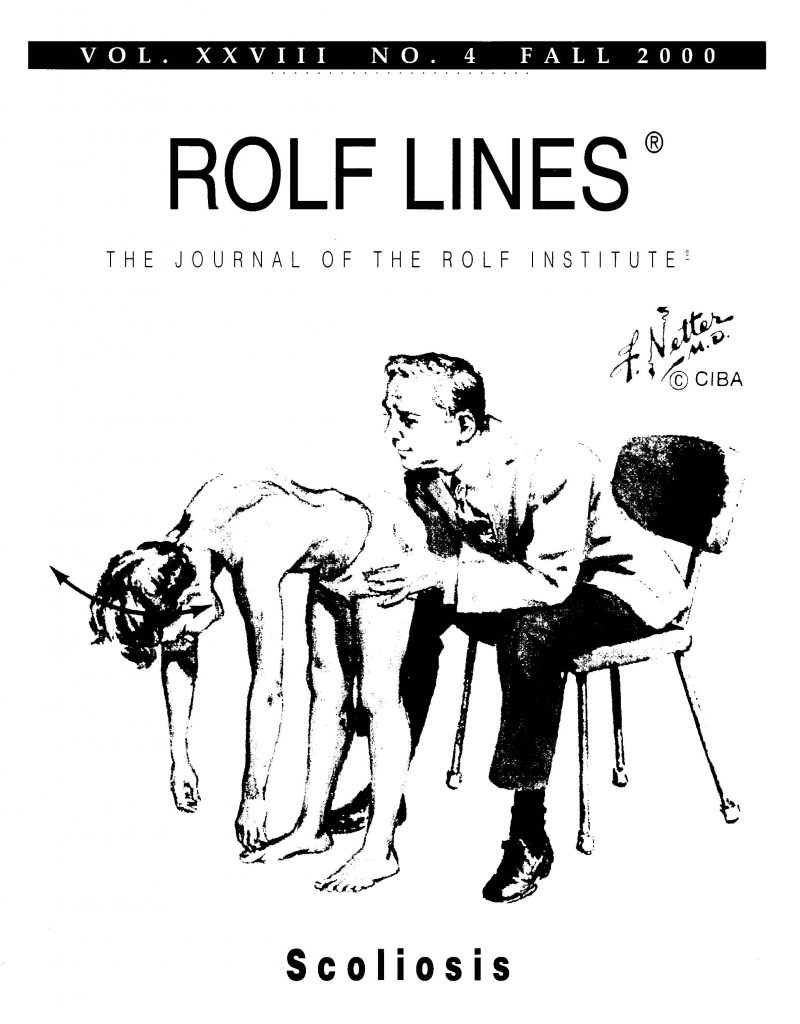
There are two kinds of scoliosis: neuromurcular (associated with a known neuromuscular disease like cerebral palsy or muscular dystrophy) and idiopathic. Idiopathic is a two-dollar word meaning. ” we don’t flow why,” and probably more than half of the cases are idiopathic. There art- thousands of teenagers and sometimes older adults, having major spinal surgery for correction of idiopathic scoliosis every’ year. I’ve been involved in a few of those surgeries myself.
There is an article in the journal Spine, “Intra operative Long-Latency Reflex Activity in Idiopathic Scoliosis demonstrates Abnormal Central Processing a possible cause of idiopathic scoliosis” by Maguire and others Spine vol. 18#12, 1993, pp 1621-26. I’m going to quote most, of the first paragraph, and then I’ll translate. At the end I’ll speculate about what this means for Feldenkrais workers and other bodyworkers.
The clinical manifestations of idiopathic scoliosis art- hell known, vet its causes remain unclear. Several factors have been proposed, including abnormal structural elements tit the spine, dysfunctionaI spinal musculature, genetic factors, alterations of Collagen metabolism, and abnormalities of the central nervous system. The most promising investigations appear to implicate the central nervous system, especially those areas involved with postural equilibrium. Spinal cord reflexes play an integral role in the maintenance of posture. These complex polysynaptic segmental reflexes are regulated by a variety of descending supra segmental systems, by peripheral afferent impulses and within the spinal cord by a network of interneurons and propriospinal neurons.”
So, in other words, there is a great deal of complex interaction between different parts of the spinal cord involved in maintaining posture, including information from the peripheral nerves, from the brain, .old interactions within the spinal cord. Messages front the brain fine tune the process of postural regulation that goes on within the spinal cord (“efferent control system”). If you’ve ever studied the anatomy of the spinal musculature, you know that there are several short muscles attached to each vertebra that can rotate it in different directions, which maintain the functional coupling of the vertebrae and determine how forces travel through the spine. Presumably this is how Feldenkrais and other body mind modalities can have an effect on posture, walking, and spinal column function: through central mediation ill the spinal reflexes, the central mediation teeing (somewhat at least) at accessible to conscious control.
The article goes en to say that the abovementioned reflex activity can be measured electrically by recording LAID. They studied 37 cases of idiopathic scoliosis and 8 cases of neuromuscular se, scoliosis (three CP, three muscular dystrophy, and two other neuro muscuIar disorders) by recording late reflex activity during spinal surgery for correction of scoliosis. What they found was that “long latency complex polysynaptic activity” was present in all 37 patients will idiopathic scoliosis, and absent in all 8 patients with non idiopathic scoliosis. (These late reflexes are also unknown in normal subjects).
In other words, when you stimulate a nerve in the leg, you can record electrical responses front a muscle in the leg. You gel an early response, say 5 milliseconds, by direct stimulation, and around 35 iris you get some later responses called H-reflexes and F-waves, which involve an impulse first going to the spinal cord and then bouncing back down the same nerve, or being relayed through a reflex arc in the spinal cord. In these idiopathic scoliosis patients ONLY, there are late responses ranging from 20 -243 ms in latency and lasting up to 4 seconds, It sounds to me like a ringing effect, a failure of damping. It’s like a car with had shocks, bouncing up and down long alter you hit the bump, when the bouncing should hatdamped out quickly.
That means that there is some complex processing, involving lots of neurological connections and hence taking a relatively long time, in the idiopathic scoliosis patients. The best, and simplest, way to think of this is that something abnormal soon thing not seen in normal subject showed up in the central nervous system processing of the idiopathic patients ONLY.
Now, I’d like to know more about that; I can think of criticisms, I’d like to see more of the waveforms, etc. If you’re interested, volt can look but the article in Spine, and they have lots of references. But assume they’re cornet. The conclusion is that ‘abnormal reflex processing may plat a role in the development of the spinal deformity in patients with idiopathic scoliosis.”‘[‘his sounds somewhat like what Feldenkrais people have been saying all along. doesn’t it?
Now, the abnormalities we’re talking about are in the spinal cord, and we don’t usually think of much learning going on in the spine, or even in the brainstem; we usually think of learning as happening in the cerebral cortex. So how can Feldenkrais, work, or other body ways, help with this kind of problem? Well, remember that them are “descending” impulses involved in the postural control mechanism of the spinal cord; in other words, higher centers can exert some degree of control over it. You can’t operate your postural reflexes by conscious thought, bill by practice, particularly by methods like tai chi, yoga, Feldenkrais, etc-, you can possibly have a very beneficial influence on them.
It would be a little late to have a beneficial effect on this process when the person has already developed a lire-threatening structural abnormality- maybe even had it corrected with multiple spinal fusions old instrumentation. However, by catching scoliosis early, and using body mind methods like tai chi, Feldenkrais, etc., it might be possible to keep idiopathic scoliosis from developing into a serious problem. By the way theoretically you could also use EMG biofeedback for this, but I don’t know if it would be practical, since it might involve either inserting needles into muscles, or delivering electrical shocks while the person tries to modify the results of stimulation. Still, I refuse to say it’s impossible.
To have full access to the content of this article you need to be registered on the site. Sign up or Register.