My imaginative, anatomical drawings thus far have been theoretically inclined. I have focused on illustrating the body’s largest, most global, natural divisions, which might be describable as its largest macro-functional units. So far I have not tried to be accurate or literal in depicting, for example, numbers of vertebral segments or ribs. Instead I have chosen to illustrate segmental interrelationships, patterns, and divisions of function. My use of diagonally wrapped cylinders, differentiation and core-sleeve nesting are ideas consistent with the basic principles governing biological form and structure as identified and described by the biologist S. Wainright in his ground-breaking work on the origins of morphology,
Axis and Circumference.’ Wainright identifies the relevant first principles, and then goes on to create a theory – as significant as Darwin’s but focused on the origins of morphology – to explain the origins of contemporary shapes of living organisms. It is interesting to note that ideas about cores and sleeves were a part of the Rolf Institute curriculum at least as early as 1985 and that Wainright’s book was not published until 1988.
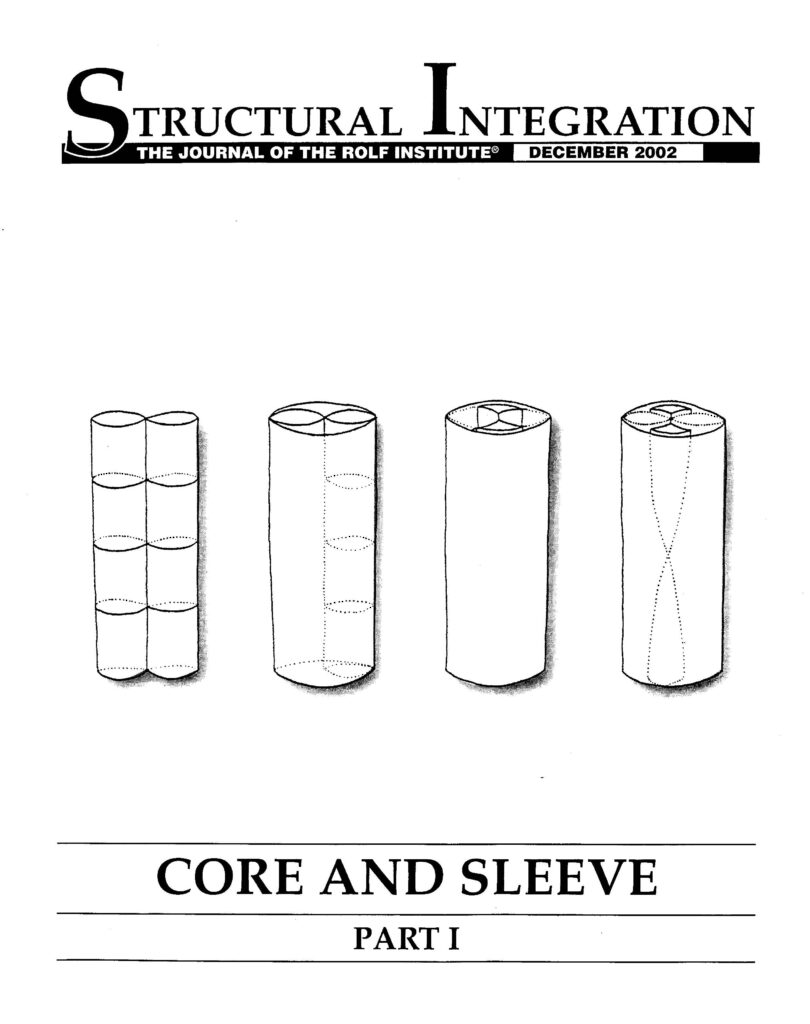
The first set of figures, A, B and C, represent geometrical extensions of Core and Sleeve themes begun in my previous article.’ In Figures D and E, I have chosen to use more structurally accurate images to portray some literal contours observable in an imaginative but very literal unwrapping of the cylindrical torso’s osseous and cartilaginous structure. Orthographic projections of this kind are used in contemporary medical / dental diagnostic imaging. Figure F is a dental X-ray showing a patient’s mandibles and maxillae nicely unwrapped in this orthographic mapping. And finally, in Figure G, imagine all the angel-chains we can make by rolling over and over in the snow or on the beach!
REFERENCES
1. S. Wainright, Axis and Circumference, The Cylindrical Shape of Plants and Animals;Harvard Univ. Press, 1988.
2. “The Cylinder Model”, Structural Integration, Dec. 2002; The Rolf Institute.
3. Figures D and E are inspired by S. Piret’s illustrations, figures 72 and 73, inLa Coordination Motrice, Aspect Mecanique de l’Organisation Psycho-Motrice del’Homme, 1971; Masson, Paris.
<img src=’https://novo.pedroprado.com.br/imgs/2003/635-1.jpg’>
A1 A unit core without a surrounding sleeve. Note the four-fold division. This division is somewhat arbitrary as there is nothing preventing a pentagon based symmetry and I invite my readers to imagine symmetries of higher orders (five-fold, six-fold, sevenfold, etc.).
A2 A unit core nested inside a sleeve. The volume of space created by surrounding the core with a sleeve communicates directly with the innermost depths of the core.
<img src=’https://novo.pedroprado.com.br/imgs/2003/635-2.jpg’>
B1 The front of a torso. Note the compartments of the sternum, abdomen and spine. The front compartment narrows at its base and could extend under the torso to merge with the posterior compartment, extending up the back.
B2 A torso design showing the front and back compartments extended above the plane of the shoulders.
C1 A core/sleeve set showing the left and right core units further spatially subdivided.
C2 Across section showing subdivision. In principle there is nothing preventing this functional subdivision from manifesting at many orders of scale, i.e., each undifferentiated compartment may be subdivided many times, at many orders of scale, eventually creating a microcellular substructure.
D An anterior view of a cylindrically unwrapped torso.
E A posterior view of a cylindrically unwrapped torso. 5
<img src=’https://novo.pedroprado.com.br/imgs/2003/635-3.jpg’>
F Cylindrical unwrapping used to visualize a dental patients mandibles and maxillae.
G We all leave a dynamic temporal signature as we whirl through space with each of our breath-cycles. Chaining our sequential breaths together might well look like this. Imagine waves of motion traveling thru this chain-like structure where each link is composed of orthogonally unwrapped torsos. Think about Breathing!!!
To have full access to the content of this article you need to be registered on the site. Sign up or Register.