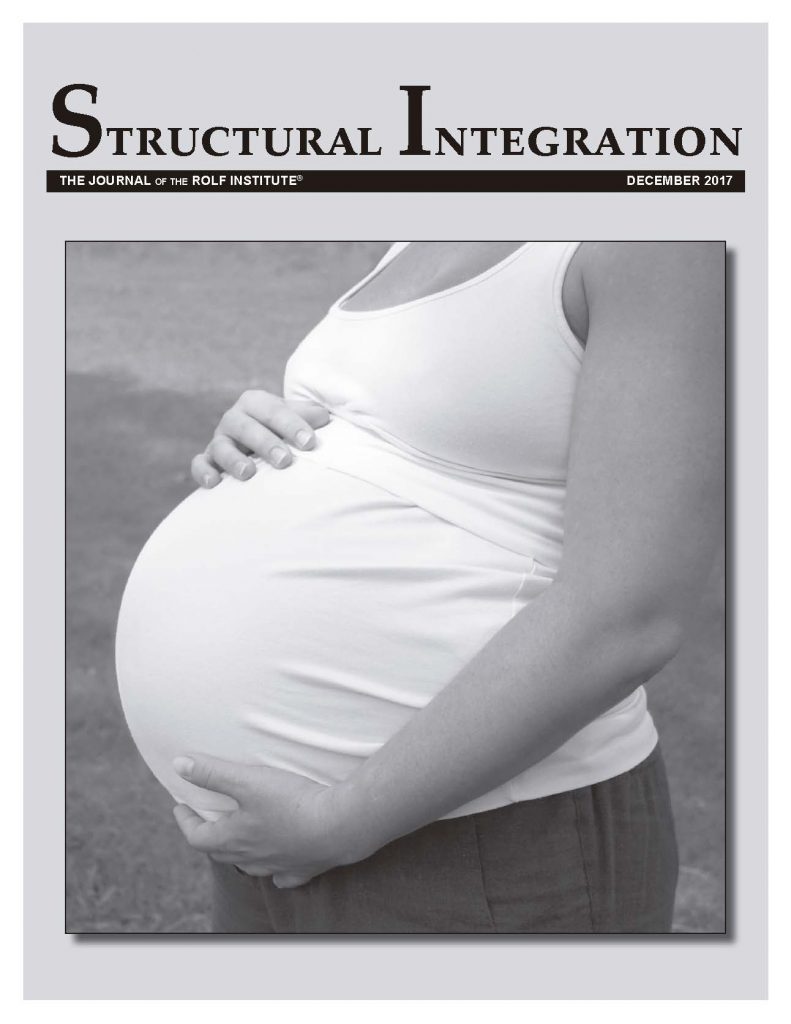
Q: Women can come to us with unique circumstances when pregnant or postpartum. Can you share something from your understanding or experience related to working at these times?
A: To say that a pregnant woman is a body in motion (to borrow from Emily Conrad) is the least of it. Not only is she changing shape, but metabolically she is awash in different hormones associated with pregnancy. She feels herself differently. She is herself, and yet in a unique state. I do not work with pregnant women on their postural evolution. I aim to keep them as stable and organized as possible, and comfortable. I do not use the Ten Series for this work, but rather have developed some other systematic approaches that seem to serve them well.
If I do nothing else, I make sure the sacrum has a horizontal base and can be in easy neutral with the spine in a supine or seated position. As pregnancy develops, the prone position becomes less and less tenable. You can use sidelying for some women, but your understanding of structure and diagnostics have to be up to speed to keep track of the organization of the sacrum in this position. If you have not been exposed to craniosacral work, this is the time to at least crack the book, if not take an Upledger Institute class.
The next big focus is how the pelvis is organized on the legs, or how the legs are supporting the weight of the body across the pelvis to the thorax. At this juncture it is useful to remember that the ilia are part of the legs, and part of the pelvic basin as well. As legs, they participate in the stride of walking with a nod anterior as the leg pushes off, and a corresponding nod posterior as the leg swings through to the heel strike. With a pregnant woman, it is not the time to do any major leg work; instead it is time to relieve the legs as much as possible. Staying below the knee, work along the anterior and posterior borders of the fibula, and along the medial border of the tibia. Add the plantar fascia, and some clearing of the medial and lateral arches, and you will have opened the interosseous membrane and the neurovascular channels. What is both mysterious and delightful is that this lower-leg intervention will often normalize the motion restrictions of the ilium and contribute to the easy neutral of the sacrum.
The reason we start the intervention with bringing the sacrum to ‘easy neutral’ is to facilitate this subtle counter-rotation of the ilia around the sacrum in walking. It should be obvious that if the sacrum is motion-restricted, then the ilia can’t complete their normal gait movements. And further, that if the sacrum is motion-restricted between the ilia, then the normal mechanics of the sacrum on the fifth lumbar also become stressed. The organization of this delicate complex of the lumbars, sacrum, and ilia is essential to the felt sense of well-being in a pregnant woman. Motion restriction here is usually at the root of low-back pain at the level of the iliac crest, and/or felt as a deep ache in the buttock.
The next major areas of stress for pregnant women are the costo-transverse junctions. A simple rib motion restriction will give no end of discomfort. The presenting symptom for this is a persistent unilateral ache/pain adjacent to the spinal ‘groove’. This is best addressed in sidelying, with systematic exploration of each rib near the discomfort until the most tender rib is located. This rib is then gently tractioned lateral and inferior. Don’t slide. After establishing depth and direction, just wait for a motile response. Your quality of touch here is everything, and your quantity of time may be ten seconds or more than a minute. This technique can be adapted from ribs three to twelve. The upper two ribs require a different approach, as they are functionally related to the neck through the scalenes and bracket the upper lobes of the lungs.
It is hard to speak of the neck without including the arms. As the arms grow out of the neck embryologically, all neck discomfort is suspect to having genesis in the way the arms are used or held. This can obviously be a two-directional situation, in which neck strains can cause real arm discomfort. For the purposes of this discussion, I’ll first talk about the neck. The primary issue in working with pregnant women is that the neck takes a lot of strain as the pregnancy develops. As the abdomen gets bigger, the woman’s instinct is to lean back to counterbalance the weight. The strain for this can be alleviated somewhat by assuring that the atlanto-occipital junction has the possibility of easy neutral (same principle as the sacrum). Remember that the head on atlas is not the primary place where rotation happens, but that this easy neutral allows adaptation to more system-wide movement patterns. The primary locus of rotation for the head on neck is between C1 and C2. It is around the odontoid process of C2 and the facets of the C1-C2 interface where most of the motion and potential neck pain come from. To establish an easy neutral here will go a long way to making the woman more comfortable.
Finally a word about arms as a factor in well-being in pregnant women. As the legs are the primary support in the biped, the arms are a primary source of balance and, of course, how we move the world. In pregnancy the arms will come under much use for changing equilibrium. As such they are liable to be a source of discomfort. Oddly they will not necessarily register pain and discomfort, but rather be a silent accessory to neck pain. It is a simple matter to relieve the general stress of the arm by working into the interosseous membrane both ventrally and dorsally along the radius and ulna, and the palmar fascia. Note that dorsal forearm work will ease trapezius and dorsal occiput pain, while ventral forearm work goes to the front of the neck and jaw. There is a lot of theory that backs this up, but for now it is fun to play with empirically and observe your results.
Taken in sum then, a coherent approach to keeping pregnant women on their feet and functional is a matter of working with the occipital region, the sacrum, and the extremities below the knees and elbows. What you have here is the pattern of ‘radial decompression’, adapted to a system in more movement than usual. (Editor’s note: see Valerie Berg’s interview with Jan Sultan on this topic, “Radial Decompression: Its Origin and Use,” in the September 2009 issue of this journal.)The only significant divergence is the attention to the costo-transverse junctions. Remember that the object is to relieve the adaptive stress of the changing body and not to perform a postural/structural overhaul as we might do in a normal Rolfing® Structural Integration (SI) intervention. Slow and easy, and if you get to see the client once a month, this working pattern will give you plenty to do, and yet not disrupt the equilibrium or the course of the pregnancy.
Jan Sultan Advanced Rolfing Instructor
A: My experience related to working with women during pregnancy and postpartum taught me to ‘do less, sense more’. During pregnancy and postpartum, there is inherent wisdom in honoring the magnitude of the change that is already taking place without adding an agenda beyond supporting the mother in her process on this gravitational planet. By coaching her to allow her weight to release into the table, you encourage her to fully exhale and plant the seeds for deep rest and restoration. When your touch is to listen first, receive second, and follow third, you educate her touch to foster attunement with her baby. By letting her experience that ‘good posture’ isn’t about holding, but about intrinsic motion, you help her adapt to her changing soma with increased ease and speak directly to her baby’s developing sensory network. When you ask how is it when the carpet comes up to meet her feet, when she moves into the space above her head, or when she imagines the air caressing her neck, you awaken her curiosity and heighten her sensory awareness so that she is able to find and renew reliable support in harmony with her environment. When you receive her with respect, compassion, and acceptance before information and technique, you both may have the opportunity to share in the experience of life creating itself.
Rebecca Carli Rolf Movement® Instructor
A: After delivery, women sometimes suffer from incontinence caused by a prolapsed uterus, particularly in activity that needs a certain stability of the pelvic floor – for instance running (after their children!), coughing, or even laughing. Working with those clients led me to the question of a ‘stable working’ pelvic floor. As a physical therapy student I learned exercises based on isometric contraction of the pelvic floor – which helps a not-moving pelvis to recover the contractibility of the pelvic floor muscles. But what happens in movement? It’s obvious that walking is difficult when we contract the pelvic floor isometrically, as then movement of the legs cannot find corresponding movement in the pelvis. This matches reports from many clients – even though they try to stabilize the pelvic floor with isometric exercises, the stabilization is not sufficient in movement.
The question leads directly into the theme of ‘core-stabilization’. From my point of view, dynamic stabilization of the pelvic floor is based on a stable core from bottom up. Practically, we look for structural limitations in the lower limbs and in the pelvis (piriformis, gluteals) that prevent the establishment of an inner stability through the pelvis into the spine (transversus, multifidii). Very often feet are a central issue in disbalance – not only in terms of the stability of the arches, but in terms of sensorial connection to the vestibular system and eyes and consequent tension patterns. These clients benefit from a well-balanced combination of structural and functional work.
Jörg Ahrend-Löns Rolfing Instructor
A: To begin with, it certainly helps to have experienced pregnancy in my own body. The slow transforming of the shape of one’s body can be either magical and elating or difficult and uncomfortable. It can be all of those also at various times. As Rolfers™, we need to be intelligent about the anatomy of a woman’s body in those changing phases.
The first three months can be tenuous in keeping the fetus attached to the uterus. Work, but work smart and cautious. Midwives over the years have taught me trigger points to avoid as they can induce labor or spontaneous abortion: ankle points, places around the thumb, and of course the pelvis in general should be avoided in those first three months.
If the client is new, I would do an abbreviated Ten Series with the needs of her changing body as the focus. The main places to attend to are the rib cage; the upper back and spine in general (compromised, and facing demands for change and to respond to increased weight on the front of the body); diaphragm; and costal arch. Please relieve them! Also, increased breast size puts pressure into the upper back and neck.
Sacrums move and need pelvic lifts that ease the strain. My daughter-in-law had me keep my hand on her sacrum through the entire labor. I literally felt my granddaughter move and ripple like an earthquake over the sacrum and my hand as she moved down and out!
I view the postpartum period as anywhere from two months after birth to five years after birth because a woman breastfeeds and then carries the child on a hip or her body and doesn’t sleep much, etc. Reclaiming her own body is the best gift Rolfing SI can give to her. The psoas muscles need attention: they got pulled off track from the belly increase and leaning back to counterbalance. Finding her ‘Line’ – the whole goal of Rolfing SI, coming back to ourselves in gravity – will find your postpartum client in ecstasy.
Valerie Berg Rolfing Instructor
A: The pregnant women I have worked with were already clients of mine who became pregnant and came because of discomfort due to pregnancy: sciatic pain, tension between the scapulae, back pain, etc. I work gently, with them sidelying or in the Sims’ lateral recumbent position, avoiding areas such as adductors, pelvic floor, sacrum, and obviously the belly. It helps to realize that the breath can release the lumbar spine, the chest, and the shoulders.
After delivery it is imperative to receive Rolfing work – the client needs to get her body back. You will sense this and it’s what my postpartum clients ask for! A rule of thumb used to be that it is better to wait until the mother is ending breastfeeding, but as it’s very common nowadays to breastfeed twelve months or more (at least in my country, Italy), I start work with postpartum women when they ask for it, as new mothers need work. I did work with one client, who was also a friend, the day of the delivery: she asked me to stay with her all afternoon, and I did it chatting, working, resting, drinking tea. She felt held and cared for, and I was very happy to be part of this beginning.
Pierpaola Volpones Rolfing Instructor Rolf Movement Instructor
A: Pregnant women already have a lot of change going on. My work with them is to help their bodies to adapt and find comfort, as much as possible, with all the changes. I find that work with radial decompression is a good way to do that. Also, it’s important to understand the role of the adductors in helping with stability when the pelvic floor is under so much pressure and the extended belly cannot offer much help in stabilizing the spine. With this understanding, I don’t feel any urgency to work with the adductors, even when the client complains of discomfort and sometimes pain there. Rather, I explain to my clients why that is happening, and that helps them make sense of the sensations and feel the stabilizing function.
There is always a need for movement education during pregnancy, particularly to help clients release tension in the back and connect to their feet. I also educate for postpartum needs: positions for breastfeeding, and what to pay attention to in their babies in terms of motor development – which most of the time brings the kids to my office.
Raquel Motta Rolfing Instructor Rolf Movement Instructor
A: When we teach the Ten Series, we often treat every person and his or her pelvis in a similar way. We are constantly working to horizontalize the pelvis, and – at least at first – we are mostly talking in the language of muscles and tendons. Over time, we get more familiar with the ligaments of the pelvis, and then, with further study, we begin to include the organs and their fascial systems in our awareness and interventions. We are aware, from the beginning, that males and females have differences in their pelvic structures. As our practice matures, we may find ourselves addressing more specific needs of the female pelvis either directly (because women come in with a concern or a question about it) or indirectly (because we find that the unique structural relationships of the female or male pelvis are involved in that horizontalization process).
For these reason, I find learning the differential anatomy of males and females useful. Just paying attention to the bony differences under your hands is a good start. From there, more formal education about the anatomy of the visceral structures that contribute to pelvic structure and stability is a good step. Learning to work both directly and indirectly with the ligamentous structures and the fascias of the organs will take the results of your work to a deeper level.
Once a practitioner has attained a comfort with working (externally) with the internal structures of women’s pelvises, he/she might want to take on the further study of working with pregnant and postpartum women. These populations benefit tremendously from careful intervention. Expectant moms need help adjusting to the new shape and weight of their bodies as their babies develop, and new moms tend to need some care in helping their bodies adjust to carrying their babies in their arms or in baby carriers. Additionally, new moms generally could use some new information about their pelvis, legs, and feet after a birth: even with an uncomplicated birth, there was a lot of rapid change in the pelvis to accommodate moving a human through it, so the postpartum period is a great time to help with reestablishing those connections. In the case of complications to a vaginal delivery or a cesarean birth, of course there are more factors to consider, including a certain amount of medical trauma and exhaustion.
My hope is that all Rolfers gain a sensitivity to differences in pelvis structures, including male/female differences, whether or not you choose to take on the specific issues of pregnancy and/or postpartum care.
Duffy Allen Rolfing Instructor
To have full access to the content of this article you need to be registered on the site. Sign up or Register.